When people talk about field-service automation, the conversation usually focuses on HVAC, plumbing, and electrical companies.
But the same problem exists across specialized trades.
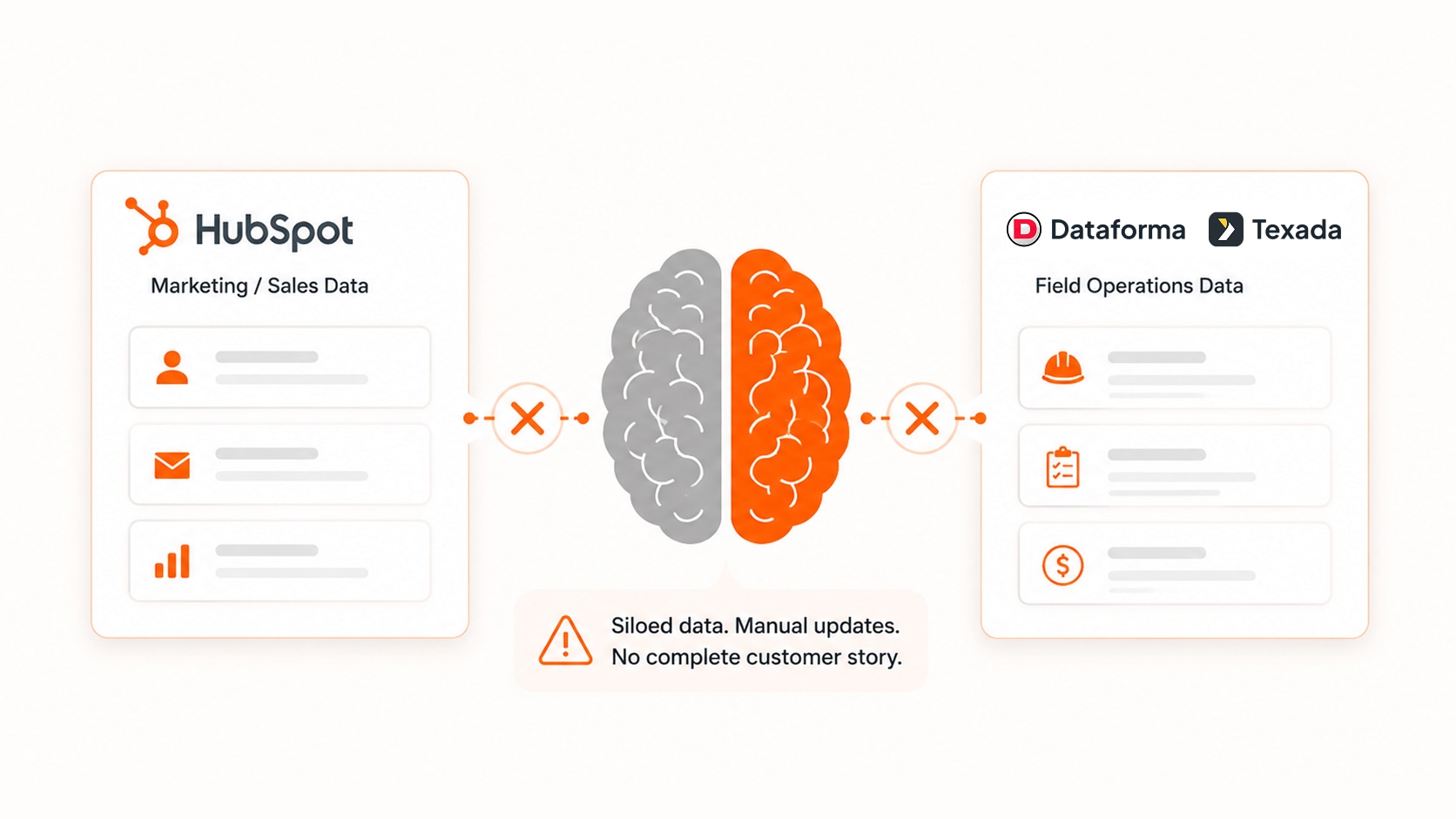
Commercial roofing companies rely on Dataforma. Heavy equipment dealers and rental businesses depend on Texada. And while these platforms are excellent at managing field operations, they often operate separately from the CRM where sales and marketing live: HubSpot.
That creates a familiar problem:
Marketing knows the customer. Operations knows the work. Neither sees the complete story.
The commercial roofer's problem
Take Mark, who runs a commercial roofing company with 40 technicians.
His marketing team uses HubSpot to generate leads and nurture property managers. His operations team uses Dataforma for inspections, warranties, service history, and project information.
The marketing campaigns work — but the data doesn't move with them.
Every new lead has to be manually entered into Dataforma. Warranty information remains trapped in the operational system, making targeted renewal campaigns difficult. And when a lead becomes a completed roofing project, the revenue stays inside Dataforma.
Mark can see which campaigns generated leads.
He can't easily see which campaigns generated revenue.
That's the HubSpot "split-brain."
The fleet manager's problem
Now consider Sarah, who runs a heavy equipment rental business using Texada.
Her sales team manages opportunities in HubSpot, while Texada handles equipment availability, rental contracts, deliveries, returns, and billing.
When a customer requests equipment, sales may need to switch between systems just to confirm availability. When a contract changes in Texada, HubSpot can remain outdated. And when a rental approaches its end date, Sarah can't automatically trigger a targeted renewal campaign if that information never reaches HubSpot.
Different industry.
Same problem: disconnected data creates operational friction and missed opportunities.
Why generic automation isn't enough
The obvious solution is to connect the systems with tools like Zapier or Make.
That works well for simple workflows:
New Lead → Create Customer
But specialized field-service platforms aren't simple databases. They contain relationships between customers, locations, assets, inspections, contracts, jobs, and invoices.
A basic trigger-action workflow can move a record.
It doesn't necessarily keep two complex systems synchronized.
As businesses grow, this can lead to:
- Duplicate customer records
- One-way data flows
- Manual reconciliation
- Missing operational updates
- Limited visibility into revenue
- Increasing workflow maintenance
The alternative — building custom middleware — can solve the problem, but it often means $15,000–$40,000 in upfront development plus ongoing maintenance.
For most growing trades businesses, that's a lot of infrastructure to own just to make their systems communicate.
synkazo: one engine for the trades
This is where synkazo takes a different approach.
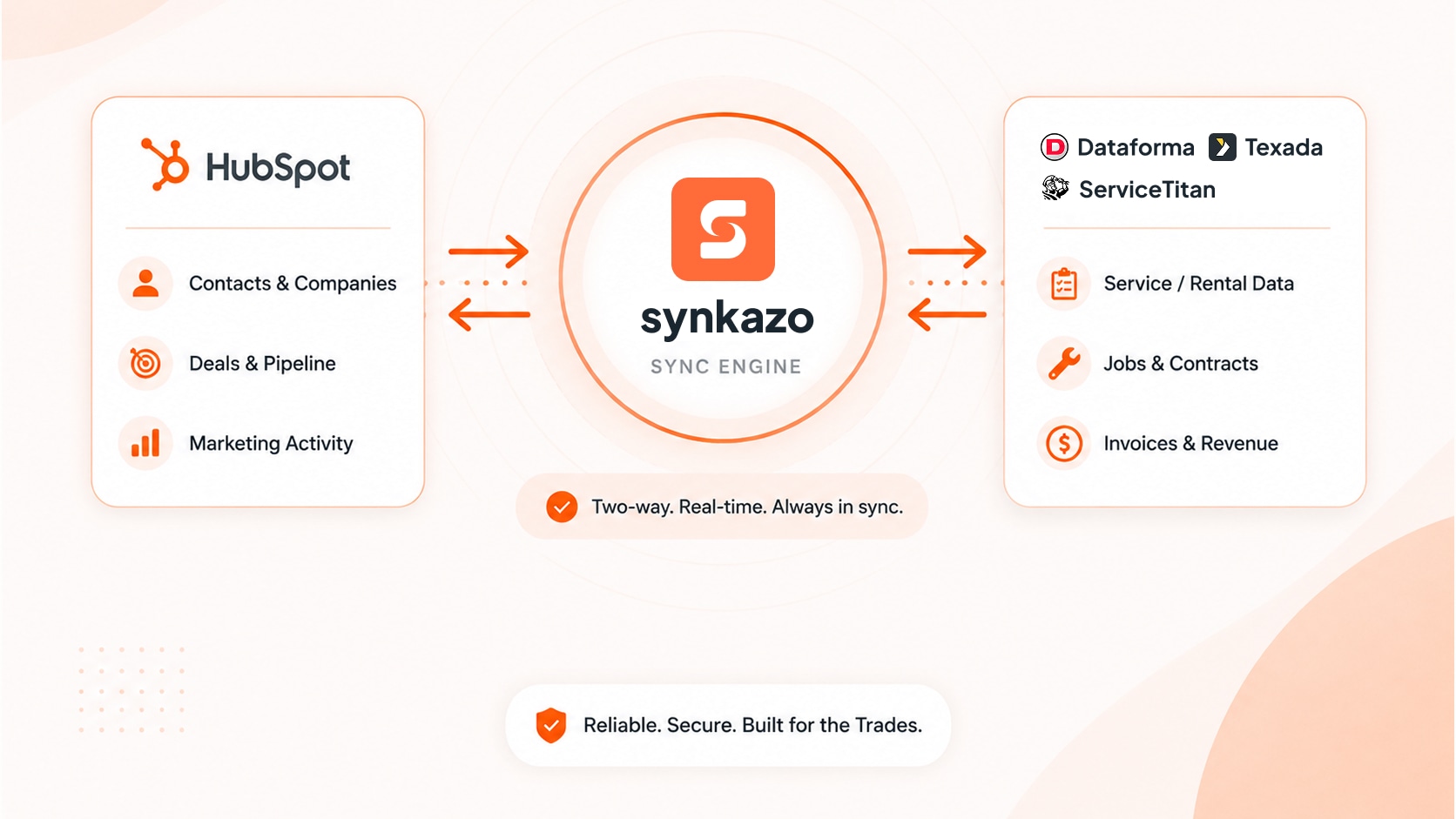
Instead of building another collection of fragile workflows, synkazo provides a ready-made synchronization engine with specialized connectors for ServiceTitan, Dataforma, and Texada.
The architecture is simple:
HubSpot ↔ synkazo ↔ Field-Service Platform
The goal is not simply to copy information. It's to keep critical business data aligned across systems.
For Dataforma users, that can mean connecting inspections, warranties, service activity, and completed revenue with HubSpot.
For Texada users, it can mean connecting rental status, customer information, contracts, and fleet activity with the sales pipeline.
And because customer identity is matched using information such as email, phone number, and physical address, the system is designed to reduce the duplicate-record problem that quickly damages CRM quality.
From disconnected data to one customer story
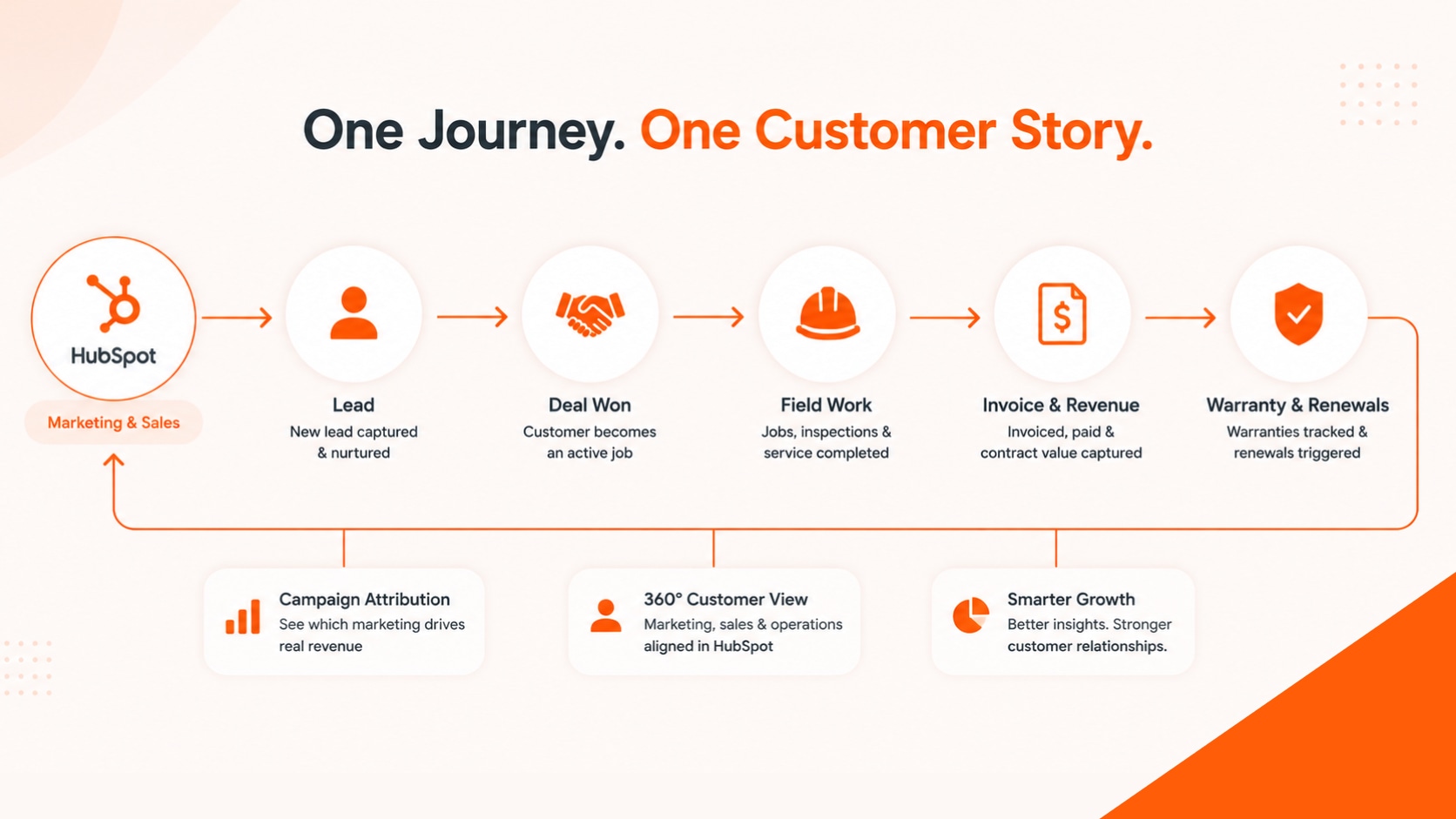
The real value isn't another integration on your technology stack.
It's what happens when your teams finally work from the same customer story.
Marketing can see what's happening in the field.
Sales can work with current operational information.
Operations can stay connected to customer relationships.
And leadership can finally connect marketing activity with completed business.
The comparison is straightforward:
| Generic Automation | synkazo | |
|---|---|---|
| Data flow | Mostly one-way | Bidirectional |
| Customer matching | Basic | Intelligent matching |
| Trade data | Limited | Specialized mapping |
| Maintenance | Your responsibility | Managed platform |
| Setup | Manual configuration | Under an hour |
Whether you're managing commercial roofing projects in Dataforma, equipment rentals in Texada, or field-service operations in ServiceTitan, the objective is the same:
Stop maintaining separate versions of your business.
Connect HubSpot with the systems that run your operations — and turn disconnected data into one complete customer journey.
Stop re-typing. Start connecting. Start growing.
We’ll connect a sandbox and map one of your real objects on the call. Thirty minutes, no slide deck.
Request a demo