For a growing HVAC, plumbing, or home services business, HubSpot and ServiceTitan can be a powerful combination.
HubSpot captures the marketing journey—who clicked an ad, filled out a form, opened an email, or became a lead. ServiceTitan manages what happens next—appointments, dispatching, technicians, jobs, invoices, and payments.
But there is a problem.
The two systems don't naturally operate as one.
This creates an expensive operational gap. Marketing sees leads. Operations sees customers. Finance sees revenue. But nobody has a complete picture of how a marketing dollar turns into a completed, paid job.
That is the real problem businesses are trying to solve when connecting ServiceTitan and HubSpot.
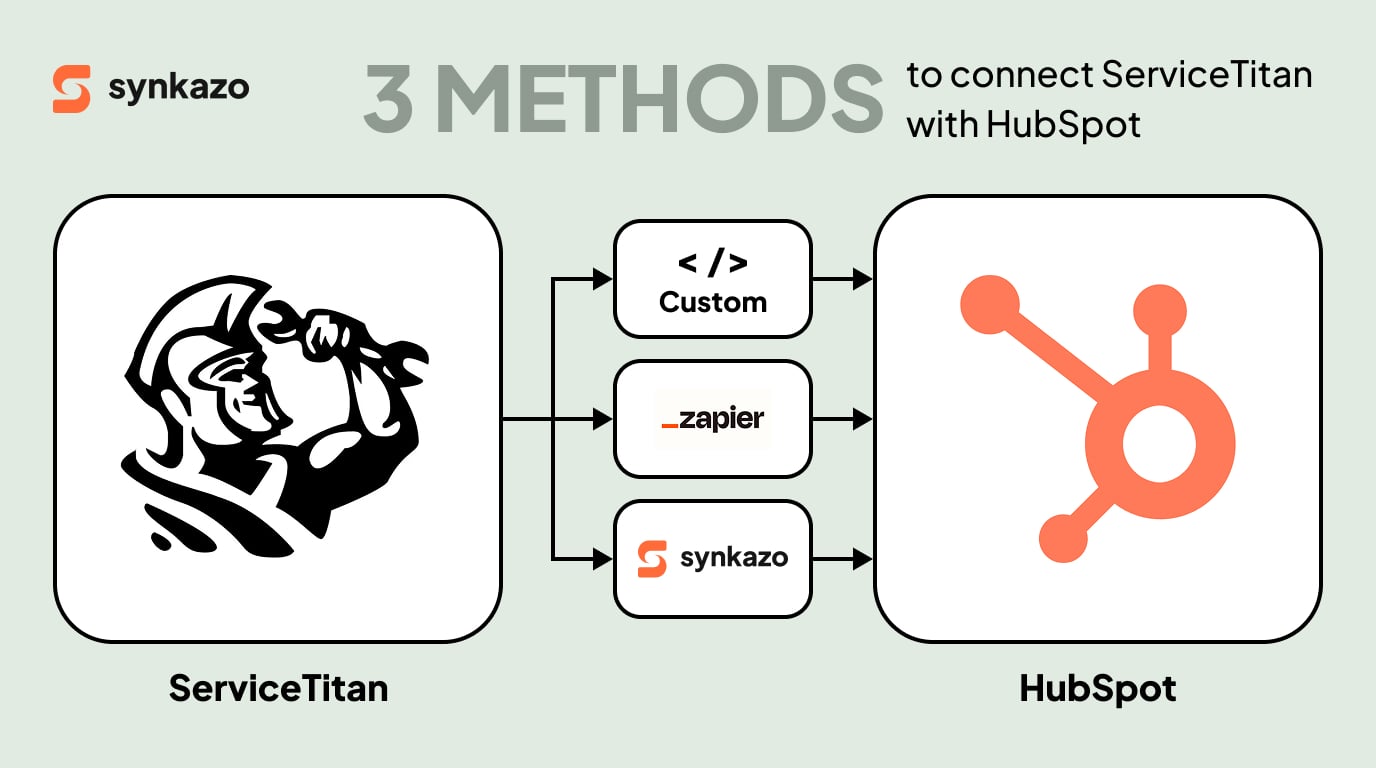
And today, there are three common ways to bridge that gap:
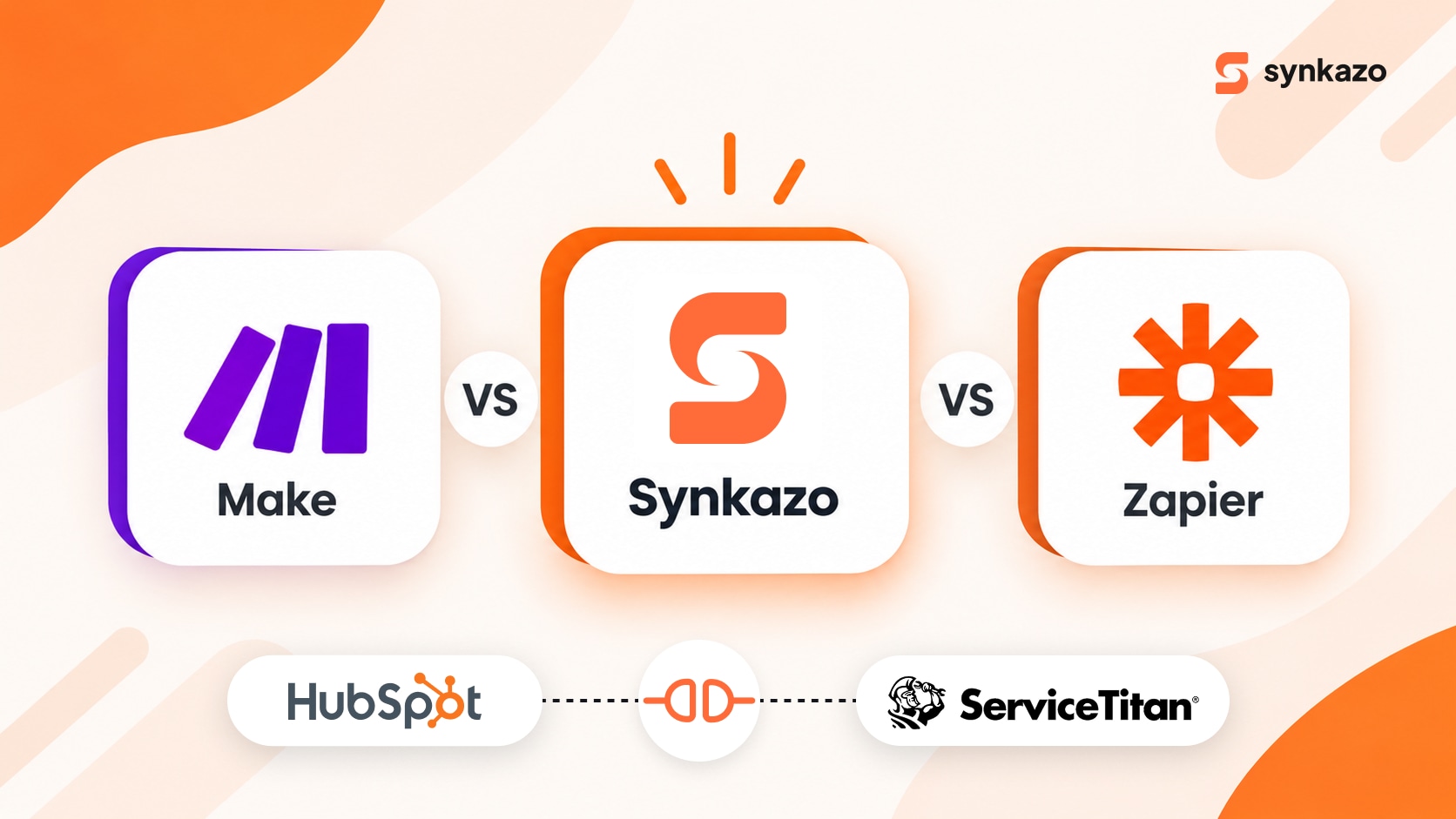
Zapier, Make.com, or Synkazo.
The question is not simply which one can connect two apps.
The better question is:
Which integration can keep your customer data accurate, your workflows reliable, and your marketing connected to actual revenue?
The Hidden Cost of Disconnected Data
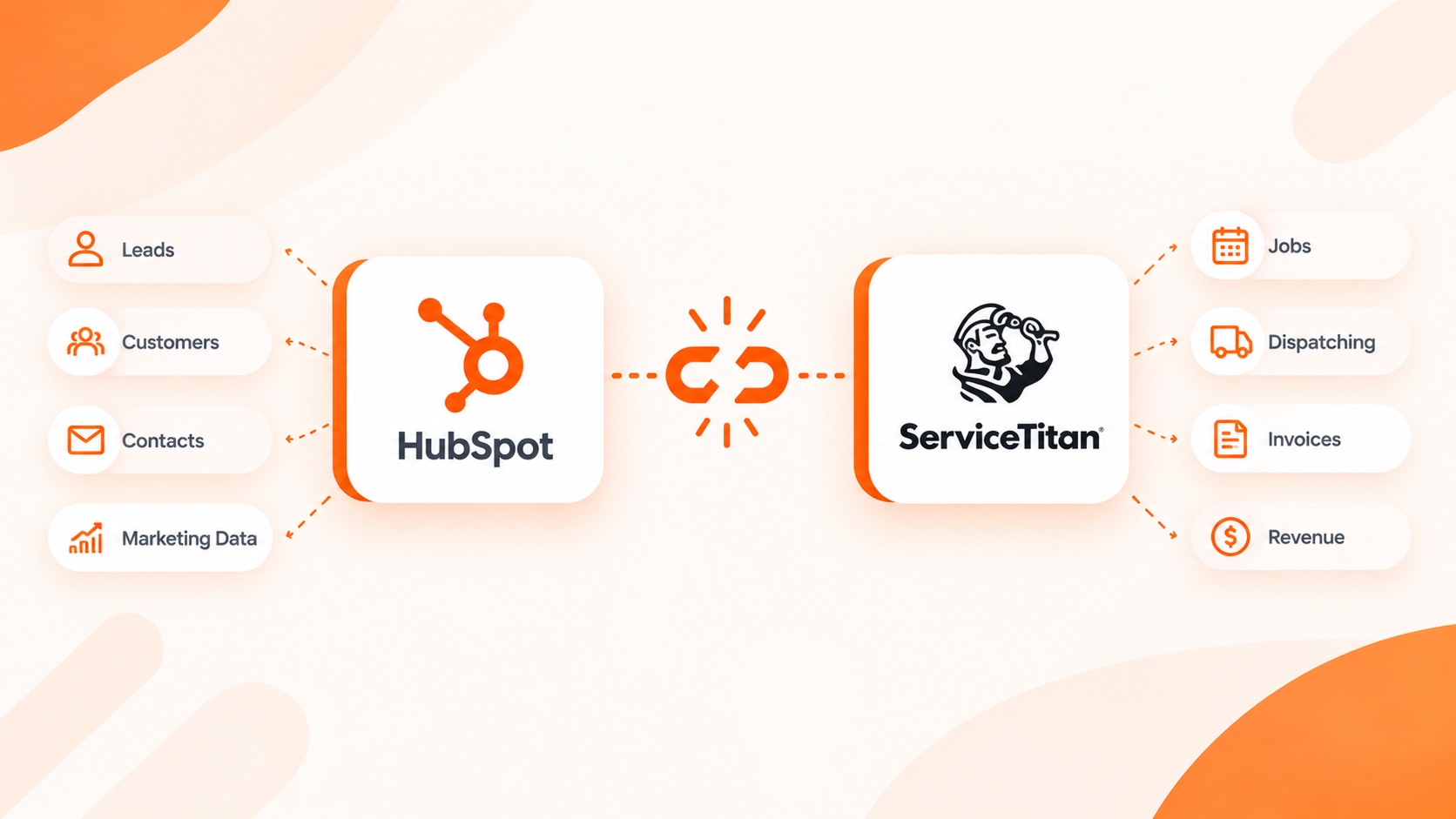
When HubSpot and ServiceTitan operate in separate silos, the cost isn't always visible on an invoice.
It shows up in wasted hours, duplicate records, missed opportunities, and inaccurate marketing decisions.
Office teams may spend significant time moving customer information between systems. Marketing teams may optimize campaigns around leads instead of profitable jobs. And leadership can struggle to answer one critical question:
Which marketing campaigns actually generated revenue?
Historically, connecting these platforms was easier. But after ServiceTitan discontinued its native HubSpot integration in 2022, businesses increasingly turned to third-party integration platforms.
That opened the door to tools such as Zapier and Make—but it also introduced another consideration that businesses cannot afford to overlook.
The ServiceTitan Certification Factor
In 2025, ServiceTitan introduced its App Certification Program, separating third-party integrations into Certified Apps and Custom Integrations.
That distinction can have a major financial impact.
Certified apps are officially vetted, listed in the ServiceTitan App Marketplace, and available across supported subscription packages.
Uncertified integrations can fall under the custom-integration requirements, potentially requiring businesses to move to ServiceTitan's premium The Works or Legacy package.
For a 10-technician company, that upgrade can represent thousands of dollars in additional annual software costs—before paying for the integration itself.
So when comparing integration platforms, the sticker price of the connector isn't the whole story.
Zapier: Easy to Start, Harder to Scale
Zapier is popular for a reason.
Its trigger-and-action approach makes automation simple:
New HubSpot lead → Create ServiceTitan customer.
For straightforward workflows, that can be enough.
The challenge appears when your integration becomes business-critical.
Where Zapier Can Struggle
ServiceTitan plan requirements: If the connector is treated as an uncertified integration, businesses may need a premium ServiceTitan plan to use it.
Duplicate records: HubSpot and ServiceTitan don't necessarily identify customers using the same logic. A simple trigger-action workflow may not understand the difference between a new customer and an existing customer with slightly different information.
Peak-season traffic: Home service businesses experience major demand spikes. When API limits are reached, workflows can encounter throttling and failed requests—exactly when reliable data movement matters most.
Zapier is excellent for simple automation.
But connecting two mission-critical business systems is much more than moving data from A to B.
Make.com: More Power, More Responsibility
Make.com—and platforms such as Workato—take automation several steps further.
Instead of a simple trigger-action workflow, you can build complex scenarios with routers, filters, conditions, loops, and custom error handling.
For businesses with sophisticated workflows, that flexibility is valuable.
But there's a catch.
You're Building the Integration Yourself
Make is a toolkit, not a purpose-built ServiceTitan-to-HubSpot synchronization engine.
Your team may need to build:
- Custom field mappings
- Customer identity rules
- Duplicate prevention
- Error handling
- Multi-step synchronization logic
- Service-location relationships
- Ongoing monitoring
And when either platform changes its API or data structure, someone has to fix the integration.
That means Make can be a strong choice for organizations with an experienced developer or RevOps team—but it can become an ongoing engineering project for everyone else.
Synkazo: Built for the ServiceTitan + HubSpot Gap
This is where Synkazo takes a different approach.
Instead of giving your team another automation toolkit to build and maintain, Synkazo is designed as a turnkey, bidirectional synchronization engine for HubSpot and the trades.
The goal is simple:
Keep HubSpot and ServiceTitan working from the same operational reality.
With Synkazo, businesses can synchronize data in both directions without building complex workflows from scratch.
What Makes Synkazo Different?
Certified marketplace integration
Synkazo is positioned as a certified marketplace app, allowing supported customers to connect without the forced premium-tier upgrade associated with uncertified custom integrations.
Bidirectional synchronization
Data doesn't simply move one way.
Updates made in ServiceTitan can flow into HubSpot, while relevant HubSpot changes can flow back into ServiceTitan—helping teams keep both systems aligned.
Smarter customer matching
Instead of blindly creating another record, Synkazo uses multiple customer identifiers—including email, phone number, and physical service address—to improve identity resolution and reduce duplicate records.
Built for high-volume operations
Peak season shouldn't mean broken integrations.
Synkazo's synchronization architecture is designed to manage API limits through queuing, batching, throttling, and retry mechanisms so data can continue moving reliably during demand spikes.
Less maintenance
Instead of forcing your team to constantly monitor and repair custom workflows, Synkazo manages the integration layer as a product.
And perhaps most importantly, the goal is speed.
Go live in under an hour—not spend weeks building an integration.
What Does the Integration Really Cost?
The cheapest integration isn't necessarily the one with the lowest monthly subscription.
You have to consider the entire Total Cost of Ownership (TCO).
For a hypothetical 10-technician HVAC or plumbing business, the comparison in the source analysis shows:
| Cost Factor | Custom API | Zapier / Make | Synkazo |
|---|---|---|---|
| 3-Year ServiceTitan Subscription | $126,000 | $162,000 | $126,000 |
| Onboarding | $15,000 | $15,000 | $15,000 |
| Integration Setup | $25,000 | $5,000 | $0 |
| 3-Year Integration Cost | $0 | $5,400 | $10,764 |
| 3-Year Maintenance | $36,000 | $23,400 | $0 |
| 3-Year TCO | $202,000 | $210,800 | $151,764 |
| Time to Go-Live | 6–8+ weeks | 4–6 weeks | Under 1 hour |
Based on these assumptions, Synkazo comes out approximately $59,036 cheaper than the Zapier/Make path over three years.
The bigger lesson is this:
Integration cost isn't just the software subscription.
It's licensing, implementation, developer time, maintenance, failures, and the cost of inaccurate data.
The Bigger Opportunity: Connecting Marketing to Revenue
But saving money isn't the most important reason to connect HubSpot and ServiceTitan.
Visibility is.
Imagine being able to follow the complete customer journey:
Google Ad Click → HubSpot Lead → ServiceTitan Booking → Completed Job → Paid Invoice → HubSpot Revenue Attribution
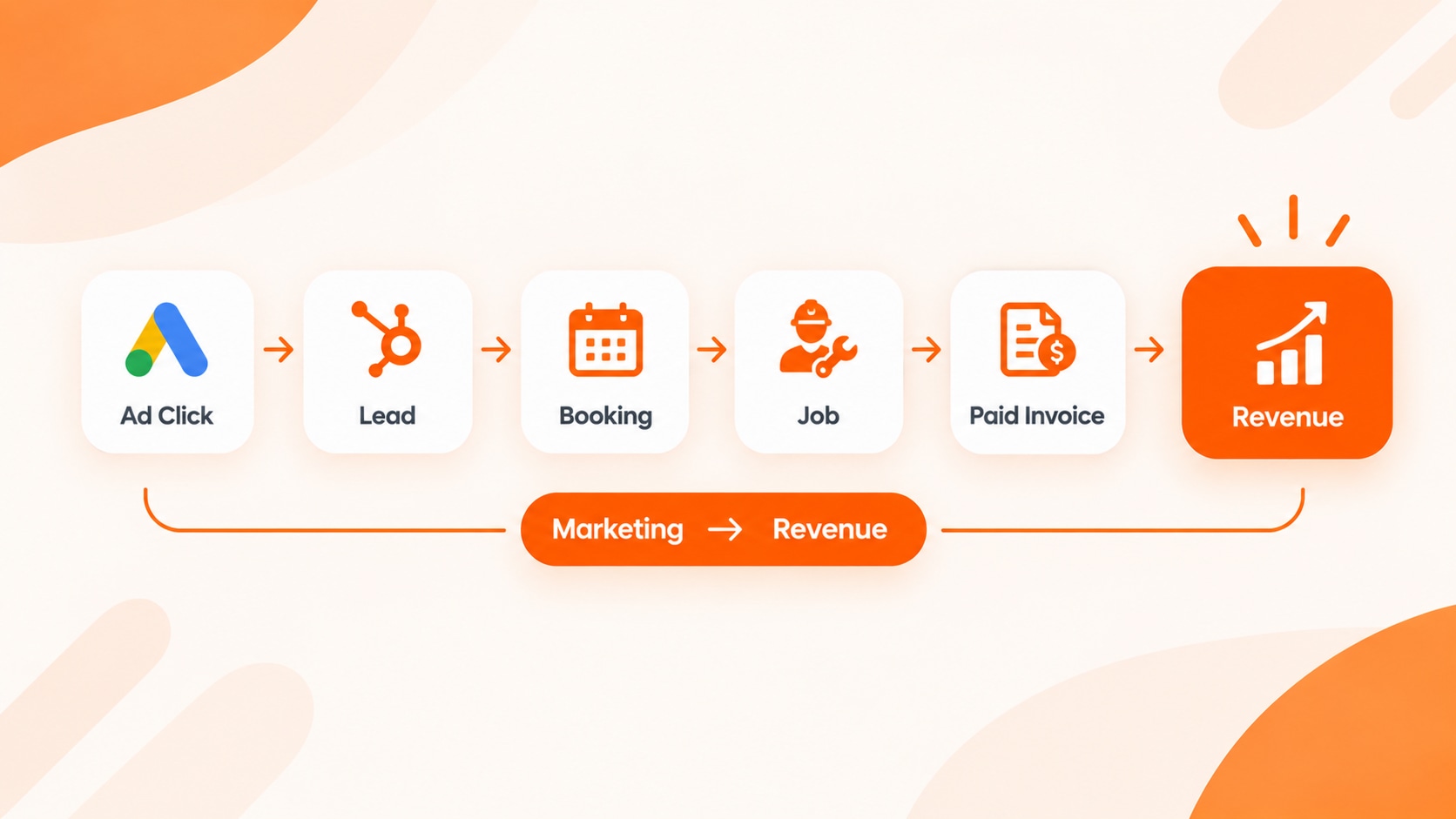
Suddenly, marketing isn't reporting on leads alone.
It can see revenue generated from those leads.
That changes the conversation.
Instead of asking:
"How many leads did this campaign generate?"
Leadership can ask:
"How much revenue did this campaign actually produce?"
The source analysis highlights Ultimate Heating & Cooling as an example, reporting a 725% increase in attributed booked revenue within four months after connecting its marketing and service data.
That's the real promise of connected operational data:
Better data → better attribution → better decisions → less wasted marketing spend.
Synkazo vs. Make vs. Zapier: Which Should You Choose?
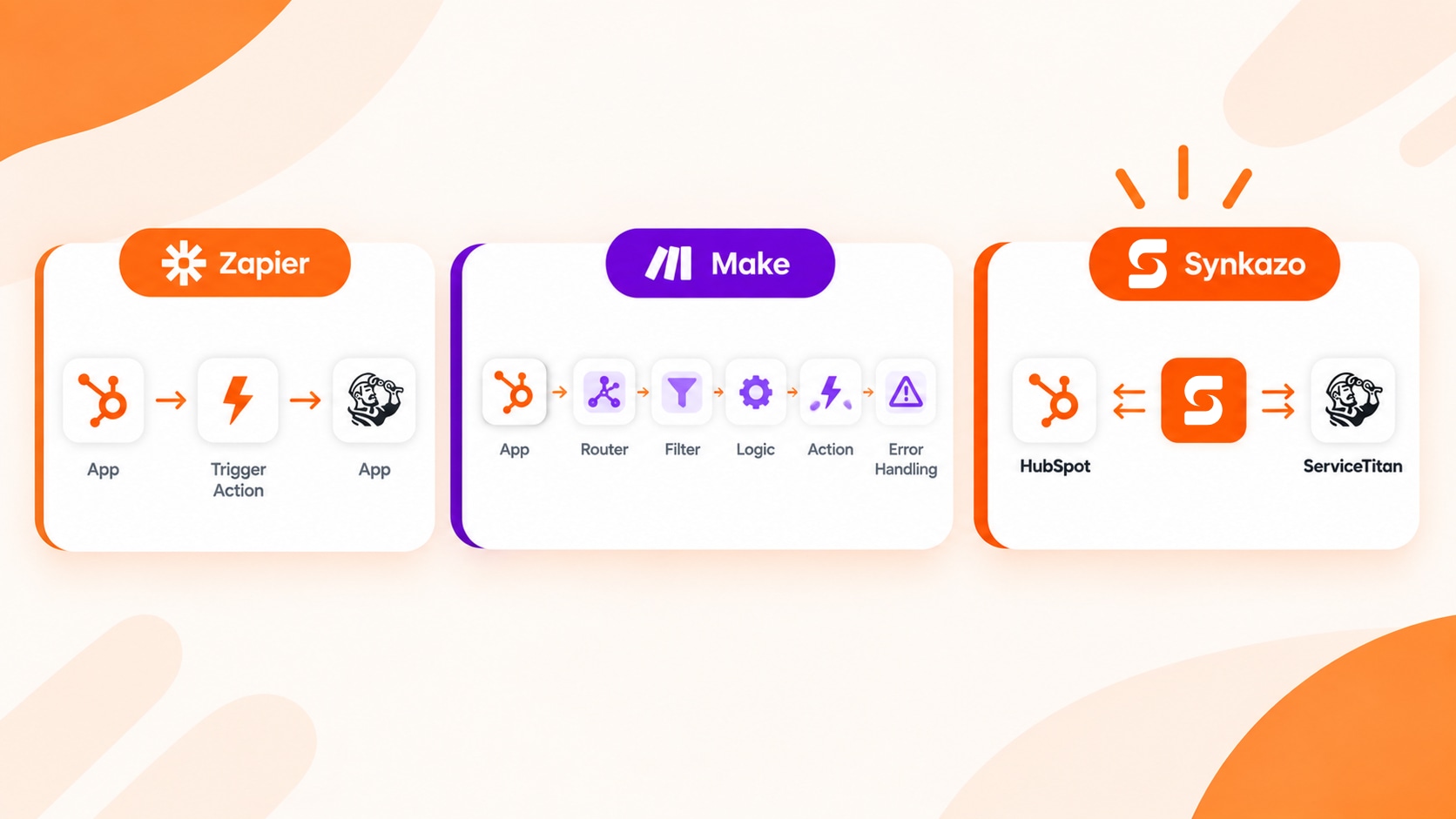
There isn't one integration strategy for every business.
Choose Zapier if:
You need simple automations, have relatively straightforward workflows, and already operate within the required ServiceTitan plan.
Choose Make.com if:
You have an internal developer or RevOps team, need highly customized workflows, and are prepared to own ongoing integration maintenance.
Choose Synkazo if:
You want a purpose-built, bidirectional ServiceTitan + HubSpot integration that minimizes development work, reduces duplicate data, handles high-volume synchronization, and connects field-service revenue back to your CRM.
The Bottom Line
Zapier gives you a pipe.
Make gives you a toolkit.
Synkazo gives you an engine built around the problem.
For a growing home services business, the goal shouldn't simply be to make two platforms exchange data.
The goal is to create one connected customer and revenue ecosystem—where marketing knows what happened in the field, operations knows what marketing promised, and leadership can finally see which campaigns are producing real revenue.
That's where ServiceTitan + HubSpot integration stops being an IT project and becomes a growth advantage.
And for businesses that want that connection without building and maintaining it themselves, Synkazo is built to make that transition simpler, faster, and more scalable.
We’ll connect a sandbox and map one of your real objects on the call. Thirty minutes, no slide deck.
Request a demo