When marketing and operations run on two different systems, key customer data gets lost in translation.
Leads come into HubSpot. ServiceTitan manages customer details, jobs, scheduling, dispatch, and invoices. Teams often end up entering the same information manually, while updates from the field never make it back to the marketing system.
That creates duplicate work, missed opportunities, outdated customer data, and lost revenue.
Historically, most companies leaned on a native connector to paper over this. ServiceTitan discontinued its native HubSpot integration, so contractors now have to choose a third-party path.
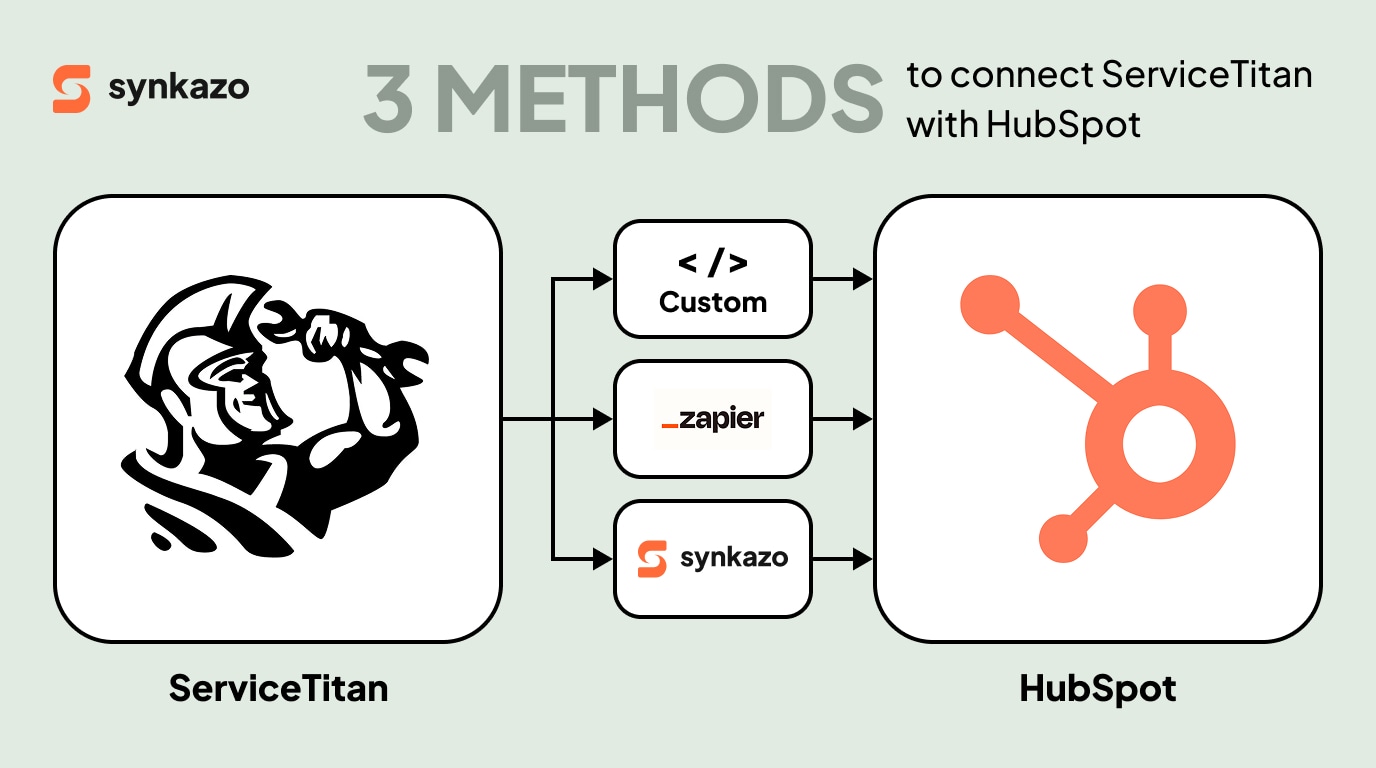
Here's how to integrate ServiceTitan with HubSpot in 2026, with a comparison of the cost, setup, and complexity of each method.
Why your disconnected data is silently leaking your profits
This is the classic "operational split-brain" problem. Your customer relationships exist in two completely different universes:
- HubSpot knows who clicked, who opened, and who showed interest.
- ServiceTitan knows who booked, who paid, and what equipment is installed in their basement.
Because these two systems don't talk, you're likely suffering from several silent business killers:
- Administrative burnout — Office staff spends 30+ minutes a day per employee re-typing the same customer data into both systems, dragging down productivity.
- Poor marketing visibility — You spend thousands on advertising but can't easily answer the one question that matters: which campaigns actually generate paying customers?
- Revenue leakage — Manual handoffs and broken processes quietly leak 15–20% of total annual revenue to errors, missed follow-ups, and lost leads.
Going the custom API route
For larger contractors, one option is to hire a development team to build a custom ServiceTitan–HubSpot integration from scratch.
Think of it as building your own private bridge between the two platforms.
How the custom build works
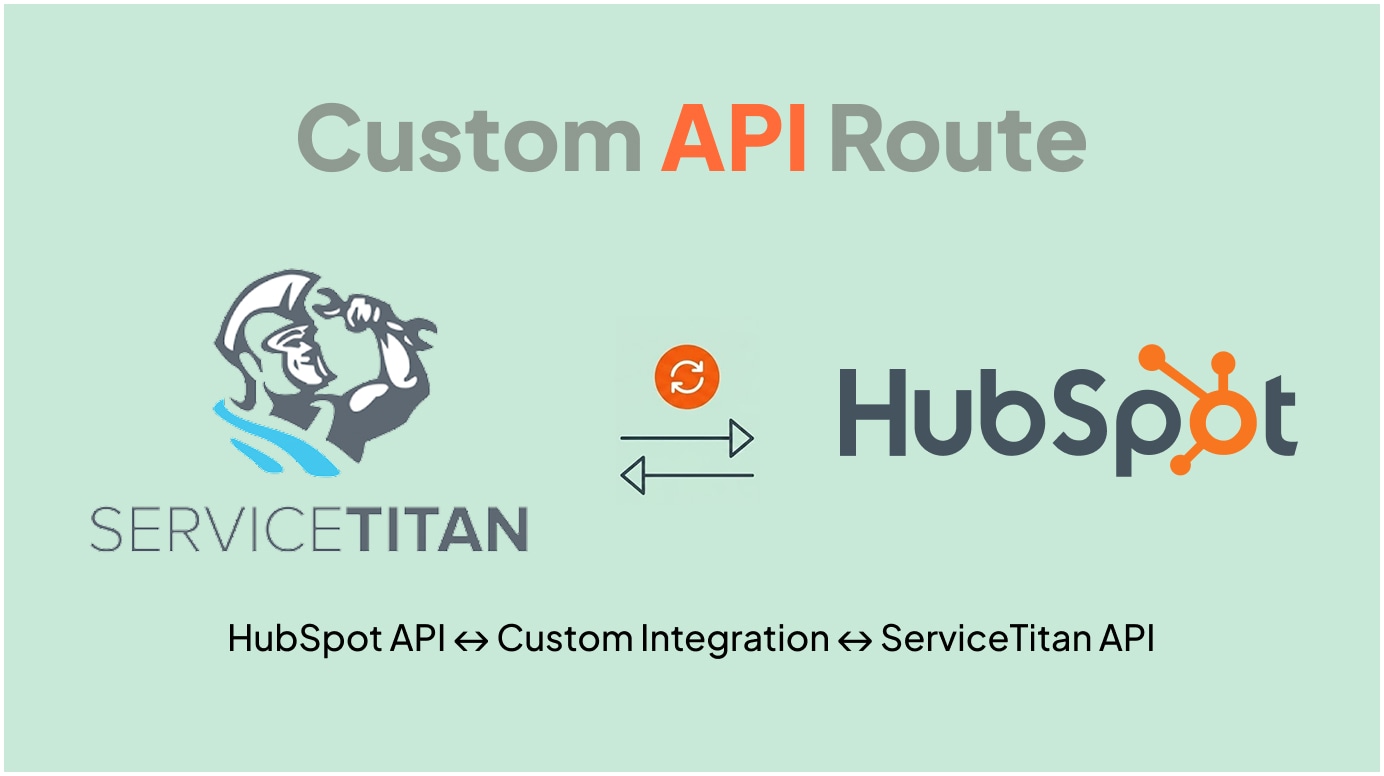
Developers study your data, build custom middleware, host it on AWS/Azure (or similar infrastructure), and connect both systems through their APIs:
HubSpot API ↔ Custom Integration ↔ ServiceTitan API
It can support two-way data sync and highly specific business rules — but there's a catch.
Where it gets expensive
- Big upfront cost — A custom integration typically runs $5,000–$20,000+, depending on complexity.
- Weeks of development — Planning, development, testing, and deployment can take 6–8+ weeks.
- Ongoing maintenance — API changes require regular updates, often adding $1,000–$2,000/month in maintenance costs.
- Developer dependency — If the original developer or agency disappears, you're left with hard-to-maintain code.
Custom gives you maximum flexibility and control, but you're also taking on the cost, development time, and maintenance burden yourself.
Zapier — the no-code way
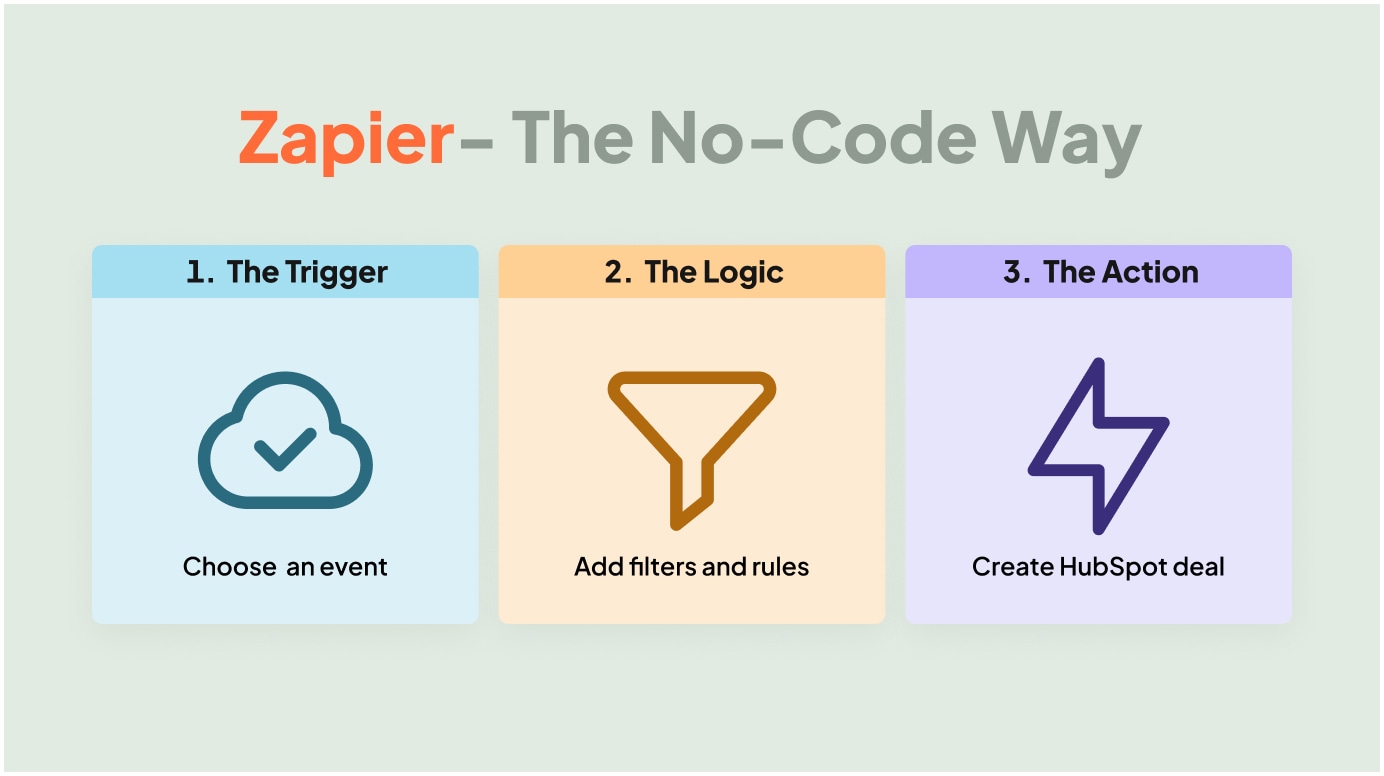
Zapier is popular for one simple reason: it's easy to get started with. Connect your apps, create a trigger, add an action, and you're done.
How Zapier works
- Connect both platforms — Link your HubSpot and ServiceTitan accounts.
- Set a trigger — Choose an event, such as a new lead or customer.
- Add an action — Tell Zapier what to do when the trigger fires.
- Repeat for other workflows — Build additional automations for updates, jobs, contacts, and other data.
It works well for simple tasks, but things get complicated once you need reliable, two-way synchronization.
Where the pipe starts to break
- One-way by default — Two-way syncing requires multiple workflows and extra logic layered on top.
- Duplicate records — Without a proper matching process, the same customer can get created more than once.
- Fragile workflows — API or field changes can break automations silently.
- Silent failures — Failed workflows can go unnoticed until data is simply missing.
- Costs can grow — More workflows, tasks, and platform tiers push the bill up over time.
Zapier is good for simple automations. But when you need reliable, ongoing synchronization between ServiceTitan and HubSpot, you need more than a pipe.
Synkazo — the turnkey bidirectional sync engine
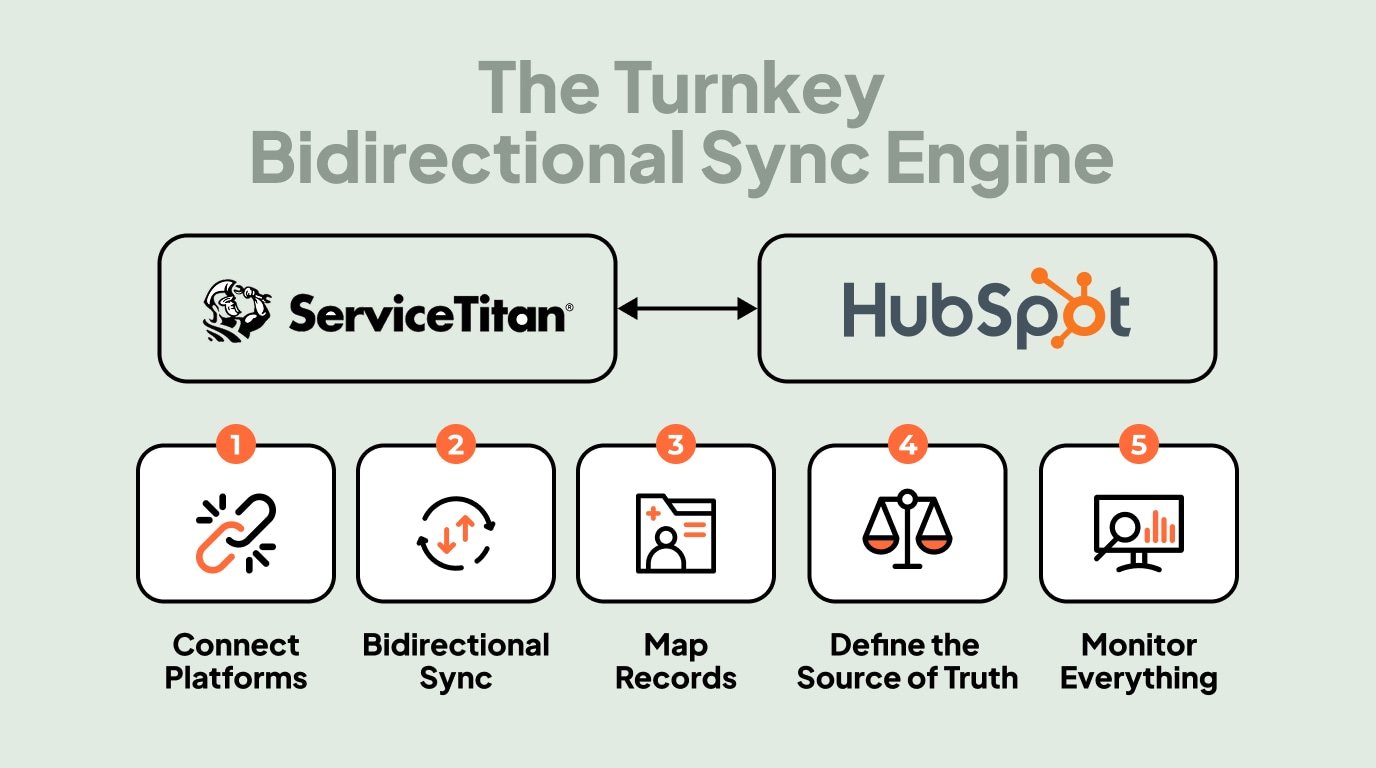
If custom development is expensive and Zapier-style automation is too limited, synkazo takes a different approach: it's a ready-to-use product, not another coding project.
synkazo is built specifically for ServiceTitan and HubSpot, and provides secure, bidirectional synchronization out of the box.
How synkazo works
- Connect both platforms — Link your ServiceTitan and HubSpot accounts.
- Bidirectional sync — Keep contacts, customers, jobs, invoices, and other supported data aligned.
- Map records — Use email and phone numbers to identify existing customers and reduce duplicates.
- Define the source of truth — Decide which system owns each type of data and controls the updates.
- Monitor everything — Built-in history logs and sync handling help you spot and resolve issues.
What makes synkazo different
- True two-way sync — Changes flow between both systems smoothly, rather than needing a separate one-way workflow for each direction.
- Built-in deduplication — It checks against existing records before creating new ones, instead of blindly duplicating.
- Better data ownership — You define which system controls which fields, so updates don't fight each other.
- Better attribution — Operational data like completed jobs and invoices flows back into HubSpot, connecting marketing activity to actual revenue.
- Lower complexity — No custom middleware, long development cycles, or agency maintenance required.
Custom integrations give you flexibility. Zapier gives you simplicity. Synkazo combines the two — a ready-to-use sync engine built specifically for keeping ServiceTitan and HubSpot data aligned.
What does it actually cost? The 3-year TCO
Here's a realistic 3-year cost comparison for a growing 10-technician HVAC or plumbing company running ServiceTitan and HubSpot.
| Cost | Custom API Build | Zapier / Make | synkazo |
|---|---|---|---|
| ServiceTitan — 3 years | $126,000 | $162,000 | $126,000 |
| ServiceTitan onboarding | $15,000 | $15,000 | $15,000 |
| Integration setup | $25,000 | $5,000 | $0 |
| Integration subscription | $0 | $5,400 | $10,764 |
| Maintenance — 3 years | $36,000 | $23,400 | $0 |
| 3-year TCO | $202,000 | $210,800 | $151,764 |
| Time to go live | ~8 weeks | 4–6 weeks | Under 1 hour |
There's no one-size-fits-all answer. The right choice depends on your business size, data complexity, budget, and integration needs.
- Zapier — Best for simple, low-volume automation and basic one-way workflows.
- Custom API build — Best for larger businesses with highly specific requirements that need complete control over the integration.
- synkazo — Best for businesses that want a ready-to-use, reliable two-way sync without the cost and complexity of building and maintaining it themselves.
Choose the approach that gives you the right balance of cost, flexibility, reliability, and scalability.
Compare each option in more detail
For a closer look at ownership and operating cost, read the custom integration build comparison. If you are evaluating automation software, the Zapier for ServiceTitan and HubSpot comparison covers matching, task usage, monitoring, and two-way behavior.
We’ll connect a sandbox and map one of your real objects on the call. Thirty minutes, no slide deck.
Request a demo