A contractor can know exactly how many leads came from Google, how many people filled out a form, and how many deals entered the sales pipeline—and still have no clear answer to one of the most important questions in the business:
Which marketing campaigns actually generated completed, paid jobs?
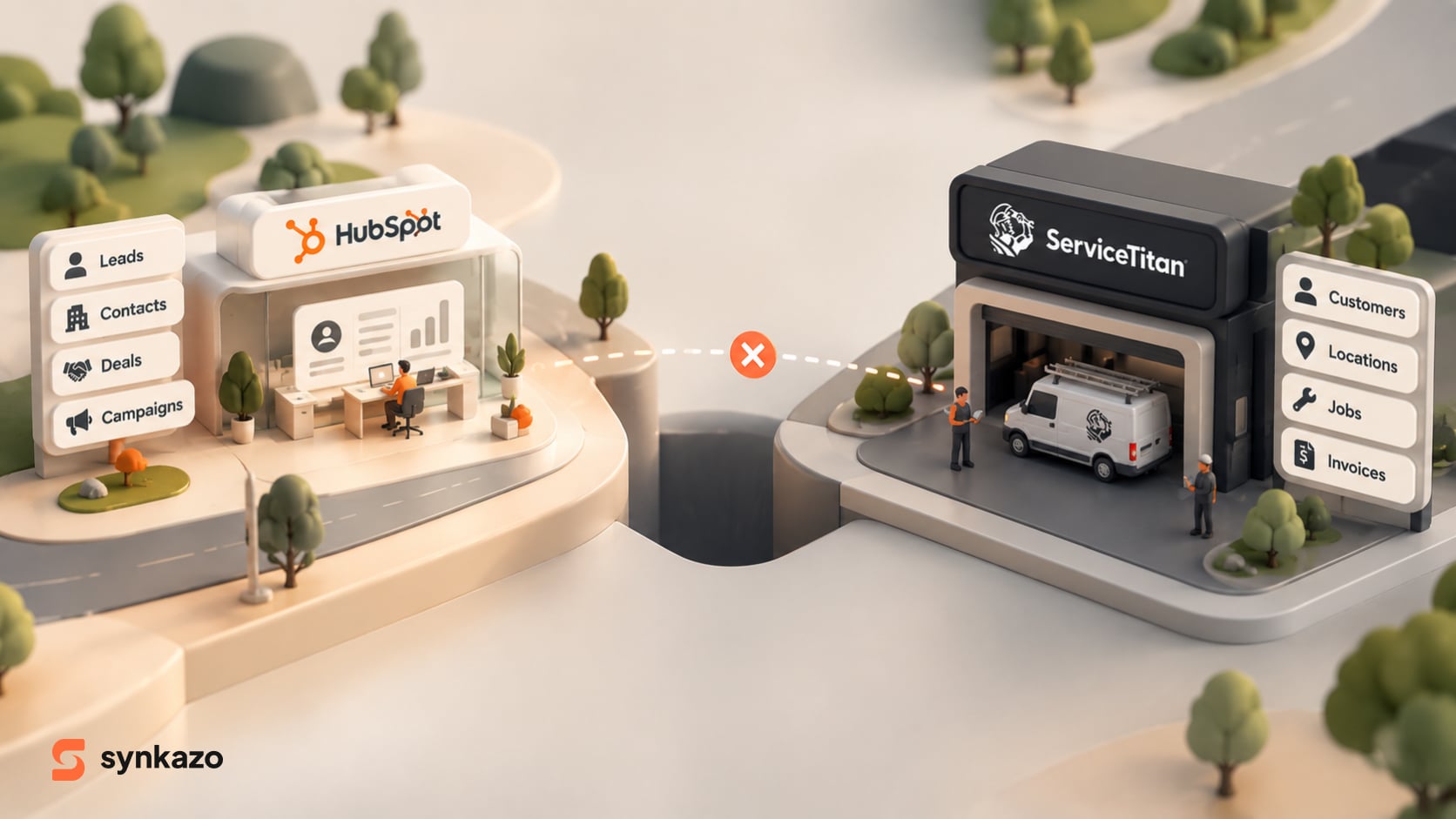
This is the operational split-brain facing many growing residential and commercial trade businesses.
Marketing and sales teams work in HubSpot, managing leads, campaigns, lifecycle stages, email engagement, and advertising data. Meanwhile, operations teams work in ServiceTitan, managing customers, service locations, technicians, jobs, equipment, estimates, and invoices.
Each platform is doing its job well.
The problem is what happens between them.
When the two systems operate as disconnected databases, the business develops two different versions of customer reality. Marketing sees the lead. Operations sees the job. Finance sees the invoice. Leadership is left trying to connect the dots manually.
And without that connection, marketing attribution, forecasting, customer data, and operational reporting all become harder than they need to be.
This guide examines why the disconnect happens, what it costs, why common integration approaches often fall short, and what a modern two-way synchronization architecture needs to look like.
1. Why the ServiceTitan–HubSpot Data Gap Happens

It is tempting to blame disconnected data on inconsistent data entry or an occasional integration failure.
But the deeper problem is architectural.
HubSpot and ServiceTitan were designed around fundamentally different views of the customer.
HubSpot Thinks in Contacts and Engagement
HubSpot is built around digital relationships.
A contact may enter the CRM through a website form, email campaign, advertisement, chat interaction, or sales activity. Email addresses and digital engagement provide much of the context used to understand that contact.
ServiceTitan Thinks in Customers, Locations, and Jobs
ServiceTitan is built around physical service operations.
A customer can have multiple service locations. Each location can have jobs, equipment, estimates, invoices, and technician activity associated with it.
That difference matters.
Consider a homeowner who calls a contractor for an emergency repair.
The CSR creates a customer in ServiceTitan using the customer's name, phone number, and service address.
Two weeks later, the same homeowner visits the website and submits a quote request using an email address.
The two systems now have information about the same person, but they may not have enough shared context to recognize that they are the same customer.
A basic integration may create another contact.
One duplicate might not seem serious.
But multiply that scenario across thousands of customers, multiple service locations, phone calls, web forms, estimates, jobs, and invoices—and data quality begins to deteriorate quickly.
The Structural Mismatch
The two platforms organize customer data differently:
HubSpot — Marketing & Sales
Contact → Company → Deal → Marketing Activity
ServiceTitan — Field Operations
Customer → Service Location → Job → Invoice → Equipment
HubSpot follows the customer relationship and marketing journey, while ServiceTitan follows the service and revenue journey. The challenge is connecting these two journeys so they represent the same customer.
The real challenge is understanding how records in two different systems relate to one another—and maintaining that relationship over time.
2. The Hidden Cost of Disconnected Data

The consequences extend far beyond messy CRM records.
When operational and marketing data remain disconnected, several parts of the business begin paying the price.
Marketing Loses the Revenue Connection
A campaign may generate hundreds of leads, but how many eventually become profitable, completed jobs?
Without operational revenue flowing back into HubSpot, marketers are often forced to optimize around leading indicators such as clicks, form submissions, or booked appointments rather than actual revenue.
That creates a dangerous feedback loop:
Campaign → Lead → Form Fill
instead of:
Campaign → Lead → Job → Completed Work → Revenue
The second chain is what leadership actually needs.
Customer Data Becomes Less Reliable
When the same customer exists under slightly different names, phone numbers, or email addresses, duplicate records accumulate.
That can lead to:
- fragmented customer histories
- inaccurate marketing lists
- repeated outreach
- unreliable reporting
- inconsistent lifecycle stages
- poor customer experiences
The CRM becomes harder to trust precisely when the business needs it most.
Administrative Work Expands
Without synchronization, office teams often become the integration layer.
Someone exports information from one system.
Someone else copies it into another.
A CSR checks whether a customer already exists.
A marketer tries to reconcile campaign data with completed jobs.
A manager builds another spreadsheet to connect revenue back to marketing.
None of this creates customer value.
It simply compensates for missing system connectivity.
3. Why Common Integration Approaches Often Break Down
When contractors decide to connect ServiceTitan and HubSpot, they generally consider two traditional approaches:
- Generic automation platforms
- A custom API integration
Both can work in the right circumstances.
But neither automatically solves the deeper problem of maintaining reliable, bidirectional business state.
Approach 1: Generic iPaaS and Trigger-Based Automation
Tools such as Zapier and Make are attractive because they make integrations look simple.
A typical workflow might look like this:
[HubSpot Trigger]
       ↓
[Automation]
       ↓
[ServiceTitan Action]
For a small workflow, that can be useful.
But a production-grade CRM-to-field-service integration is considerably more complicated.
The challenge is not simply:
"When X happens, send Y."
The real questions are:
- Is this the same customer?
- Which service location does this belong to?
- Has this record already been synchronized?
- Which system owns this field?
- What happens if both systems change?
- What happens when hundreds of transactions arrive simultaneously?
- What happens when an API rate limit is reached?
- How do we recover from a failed transaction?
Generic trigger-action automation was not necessarily designed to solve those problems.
Without persistent state, identity resolution, queuing, retry logic, and field-level ownership, a collection of simple automations can gradually become a fragile collection of workarounds.
Approach 2: Custom API Middleware
The other option is to build the integration from scratch.
A custom architecture might look like:
[HubSpot API]
      ↕
[Custom Middleware]
      ↕
[ServiceTitan API]
This offers flexibility.
It also transfers the responsibility for the integration to the contractor and its development team.
The initial development is only the beginning.
APIs evolve. Authentication requirements change. Objects and fields change. Business rules change. Edge cases emerge as transaction volumes grow.
The company therefore owns not only the integration—but also its ongoing maintenance.
For a business whose core competency is HVAC, plumbing, electrical, roofing, or another trade, maintaining integration infrastructure can quickly become an expensive distraction.
4. What a Reliable Two-Way Sync Actually Requires

A robust ServiceTitan–HubSpot integration needs to do more than move records.
It needs to understand business relationships, ownership, identity, and state.
Four capabilities are particularly important.
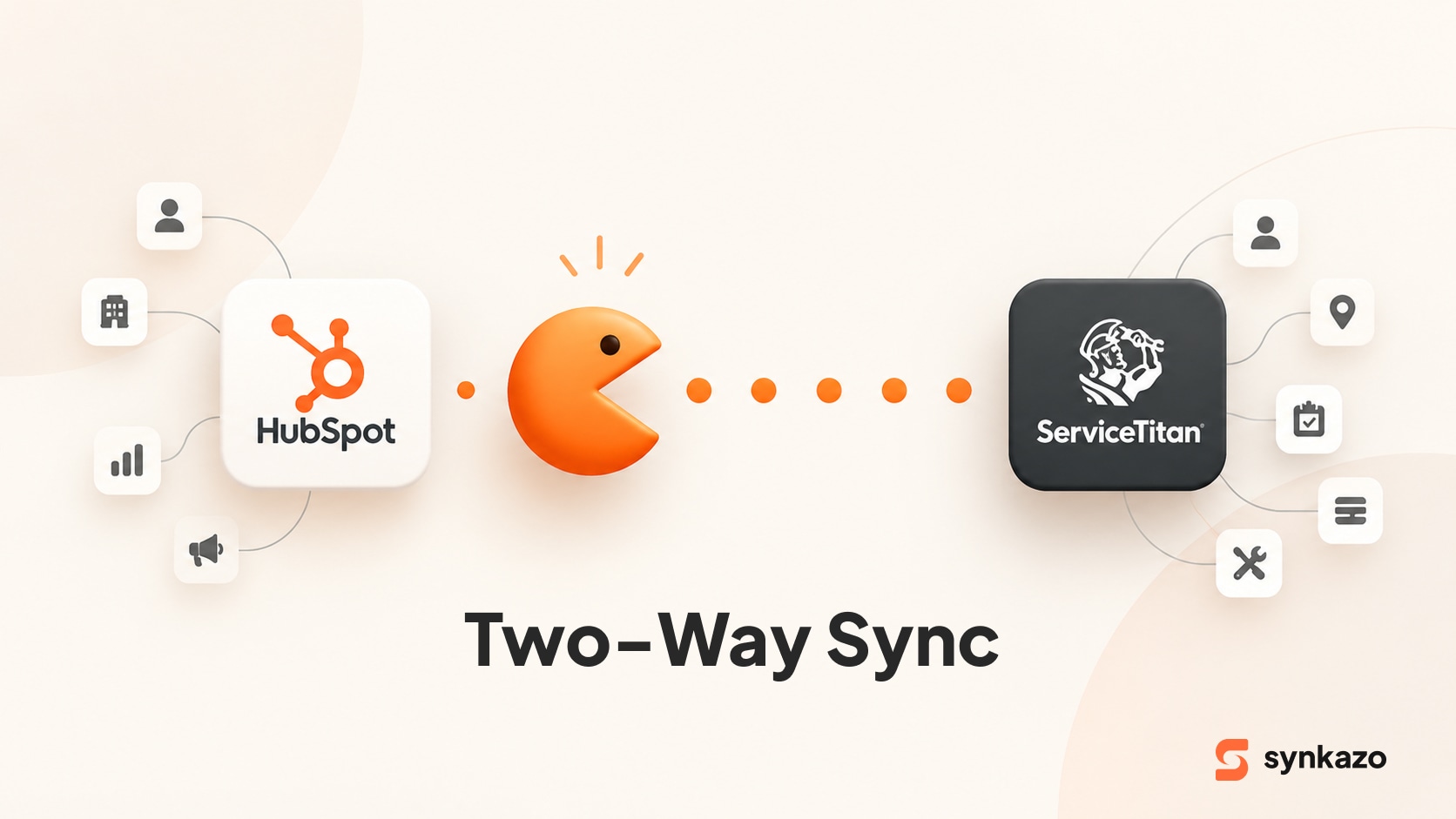
1. Bidirectional Synchronization and System-of-Record Governance
Both platforms need to communicate, but they should not compete over ownership of every field.
A practical architecture establishes clear ownership.
ServiceTitan can remain the source of truth for operational information such as:
- service addresses
- billing information
- technician activity
- job status
- estimates
- invoices
- operational records
HubSpot can remain the source of truth for digital marketing information such as:
- original source
- campaign data
- lifecycle stage
- marketing engagement
- email preferences
This prevents the integration from becoming a constant battle over which system should overwrite which value.
2. Intelligent Identity Resolution
The integration must determine whether an incoming record represents an existing customer or a genuinely new one.
A simple architecture might use multiple attributes together:
Customer Match
=
Email
+
Phone
+
Service Address
The exact matching strategy can vary by business, but the principle is critical:
Do not create a new customer simply because one identifier does not match perfectly.
Instead, the integration should use available context to resolve identity and preserve the relationship between customer, company, service location, job, and revenue.
3. Queueing, Throttling, and Recovery
Field-service businesses are not evenly distributed throughout the year.
Demand can spike dramatically during extreme weather or seasonal periods.
That means an integration needs to be designed for bursts, not just average traffic.
Instead of immediately pushing every transaction through an API, a resilient architecture can use:
-
queues
-
batching
-
checkpoints
-
throttling
-
retry mechanisms
-
exponential backoff
-
error handling
The goal is simple:
A temporary API constraint should delay a transaction—not permanently lose it.
4. Closed-Loop Revenue Attribution
This is where synchronization becomes strategically valuable.
Imagine the complete customer journey:
Google Search
     ↓
HubSpot Lead
     ↓
ServiceTitan Customer
     ↓
ServiceTitan Job
     ↓
Completed Invoice
     ↓
Revenue Synced to HubSpot
     ↓
Campaign ROI
Now marketing does not have to ask:
"How many leads did this campaign generate?"
It can ask:
"How much completed revenue did this campaign generate?"
That is a fundamentally better business question.
It allows leadership to evaluate marketing based on actual operational outcomes rather than activity alone.
5. Where Synkazo Fits
This is the problem Synkazo is designed to solve.
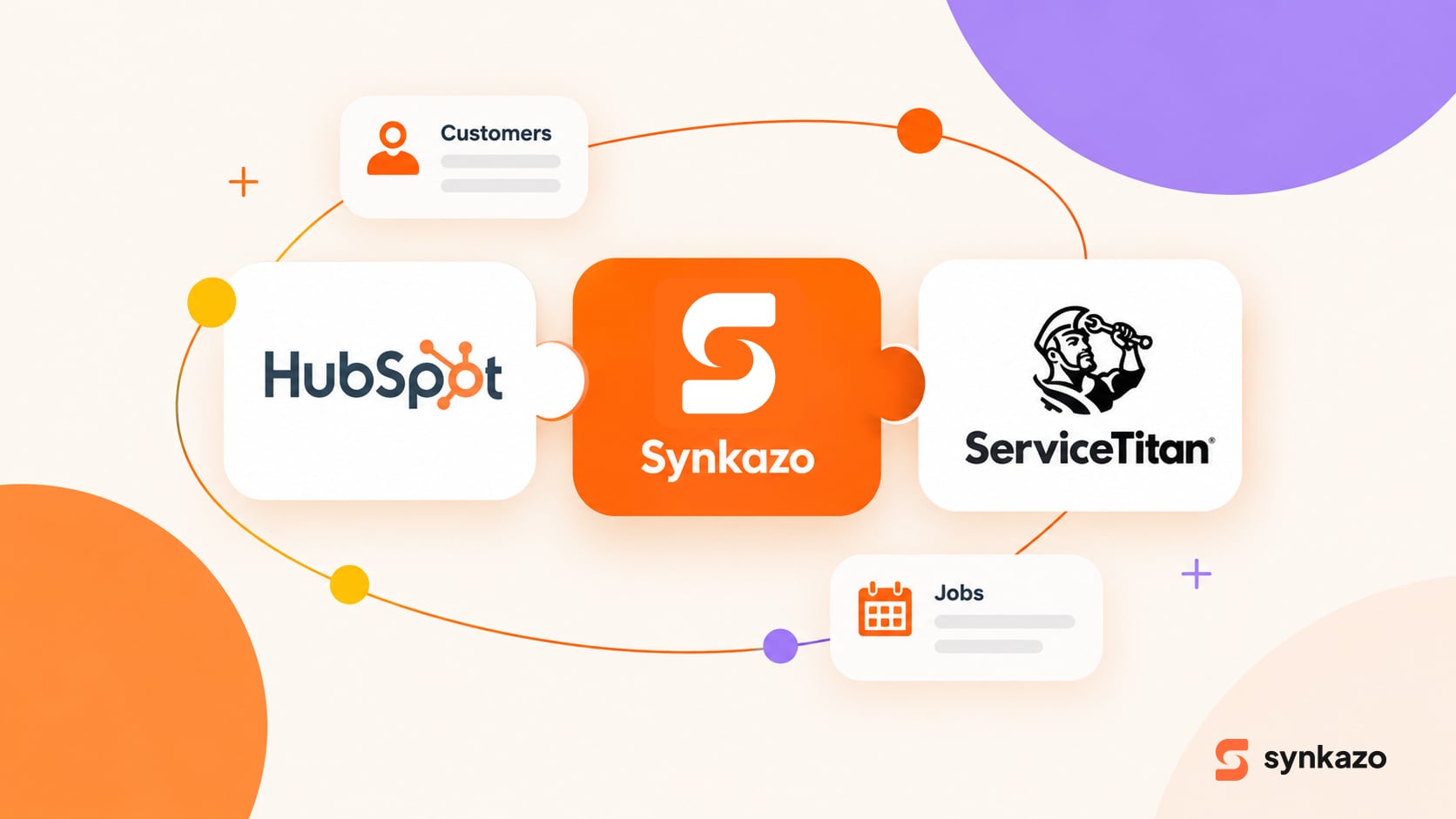
synkazo provides a purpose-built integration layer between HubSpot and field-service platforms such as ServiceTitan and Dataforma, plus one-way Texada-to-HubSpot sync, without forcing the business to build and maintain its own integration infrastructure.
                 ┌── ServiceTitan
                  │
[HubSpot] ←── [Synkazo] ──→ Dataforma
                  │
                  └── Texada
Rather than treating the integration as a collection of individual automations, Synkazo is designed around the broader synchronization problem:
identity + relationships + state + reliability + attribution.
Why a Purpose-Built Engine Matters
1. Two-way synchronization
Information can move between HubSpot and the field-service platform, helping both teams work from a more consistent view of the customer.
2. Automated record matching
Instead of treating every incoming record as new, the integration can use customer information to maintain relationships and reduce duplicate creation.
3. Operational resilience
Queueing, throttling, and retry mechanisms help the integration remain reliable when transaction volumes increase.
4. Faster deployment
A productized integration removes much of the development effort associated with building a custom middleware layer from scratch.
5. Less ongoing engineering overhead
The integration provider manages the underlying API connectivity, reducing the burden on internal teams to maintain custom integration code.
6. The Business Impact: From Disconnected Systems to One Customer Story
The real value of a two-way integration is not the API connection itself.
It is what the business can do once the connection exists.
A marketing manager can see what happens to leads after they enter ServiceTitan.
A sales manager can see operational activity alongside CRM pipeline data.
An executive can connect marketing investment to completed jobs and revenue.
An operations leader can work with cleaner customer records and better visibility into demand.
Instead of two systems telling different stories, the business begins working from one connected customer journey.
7. The Bigger Picture
The ServiceTitan–HubSpot integration problem is ultimately not a technology problem.
It is a business visibility problem.
Your marketing team knows where leads came from.
Your sales team knows what is in the pipeline.
Your field team knows what jobs are scheduled.
Your finance team knows what has been invoiced.
But if those systems cannot communicate reliably, leadership still cannot see the complete picture.
That is the operational split-brain.
And as a contractor grows, the cost of that split becomes harder to ignore.
A reliable two-way synchronization layer brings those systems together—connecting the lead in HubSpot to the customer in ServiceTitan, the customer to the job, the job to the invoice, and ultimately the invoice back to the marketing source.
That is the difference between simply moving data and creating operational intelligence.
For businesses looking to eliminate that gap without building and maintaining a custom integration themselves, Synkazo provides a purpose-built path to connect the front office with the field.
We’ll connect a sandbox and map one of your real objects on the call. Thirty minutes, no slide deck.
Request a demo