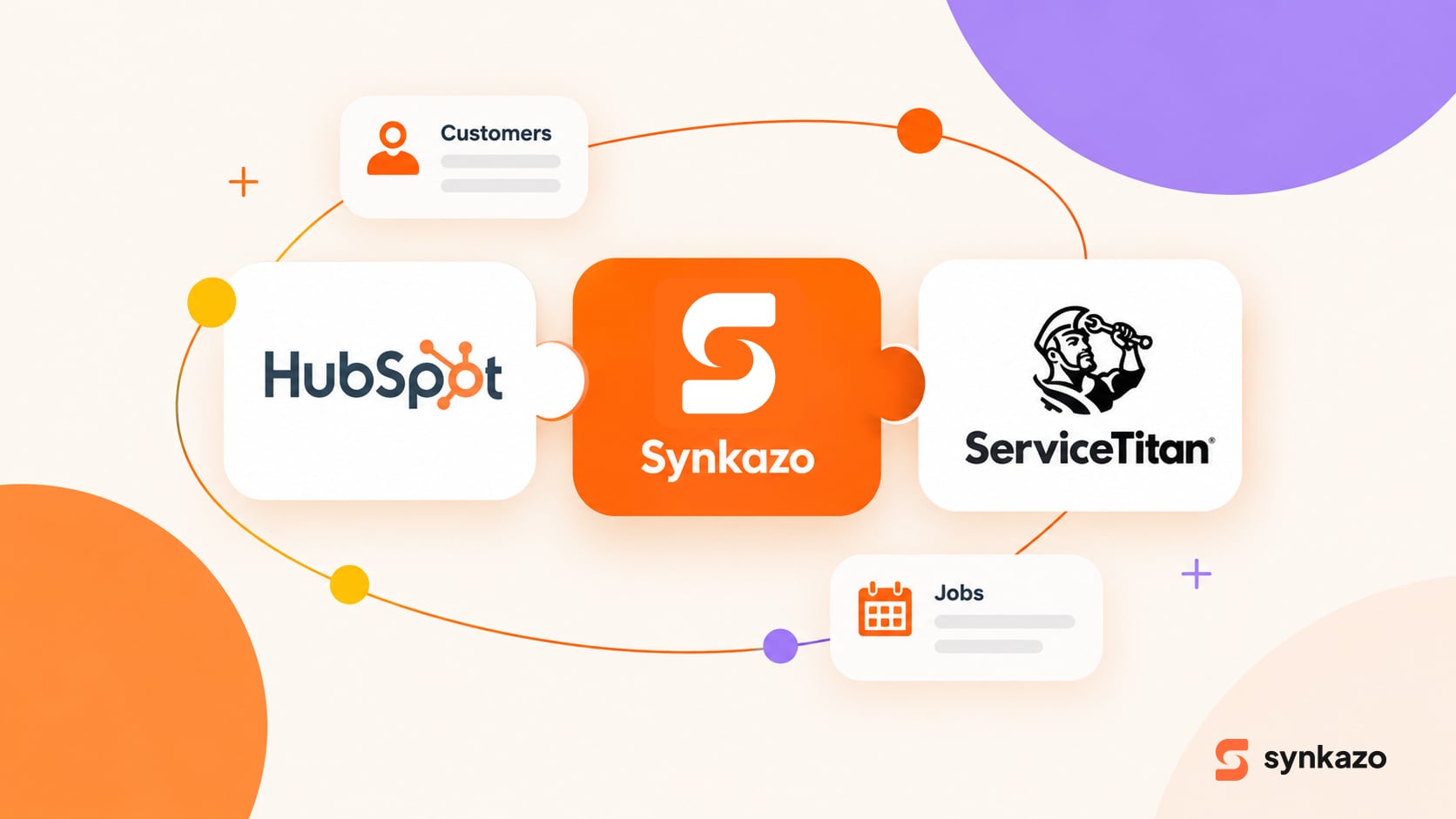
Every day, a familiar sequence plays out inside thousands of trade businesses.
A technician finishes a job. The customer signs off on the work. The job is closed, and ServiceTitan generates the invoice.
From an operations perspective, the job is complete. The revenue has been recorded.
But then something important happens—or, more accurately, doesn't happen.
That invoice often stays inside ServiceTitan.
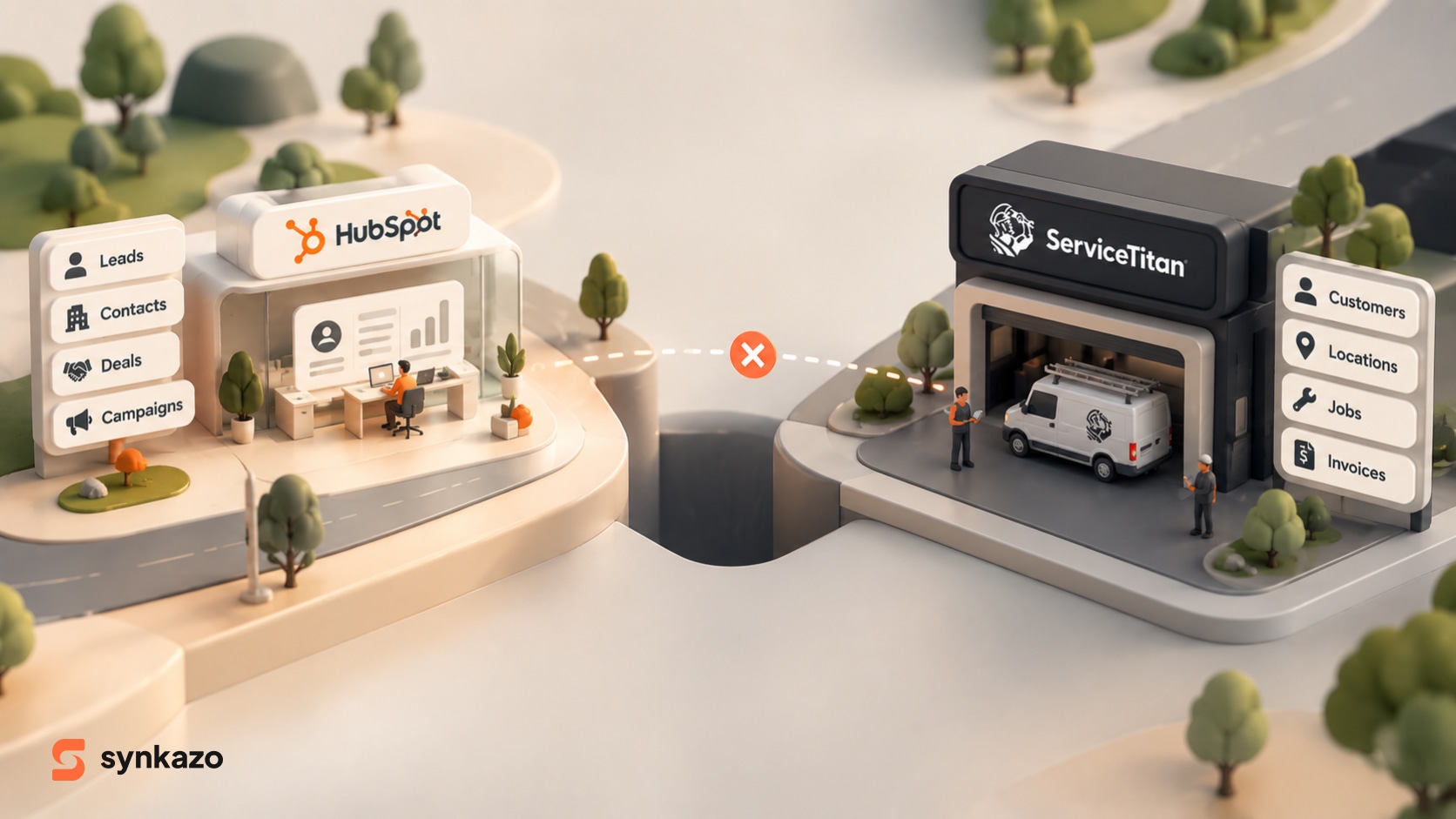
Meanwhile, the marketing and sales teams are working in HubSpot, looking at leads, campaigns, contacts, and deals without seeing what ultimately happened to those customers in the field.
The result is a frustrating gap between where a customer came from and what that customer was ultimately worth.
Marketing knows which campaign generated the lead. ServiceTitan knows how much the completed job generated. But neither system has the complete story.
This is the operational split-brain.
And for growing contractors, it can become a surprisingly expensive problem.
The Real Cost of Siloed Invoice Data
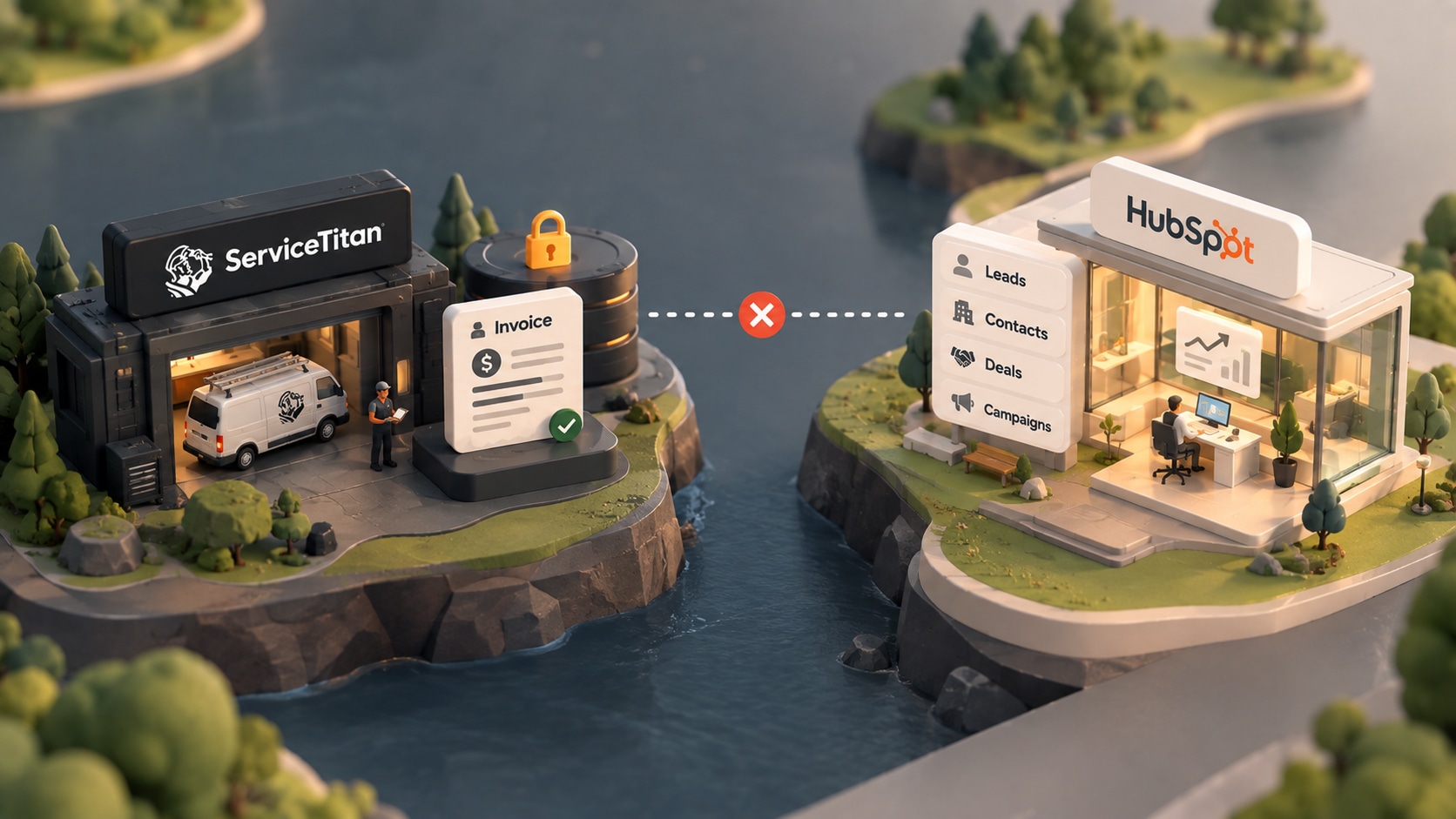
When ServiceTitan invoices do not flow back into HubSpot, the problem goes far beyond reporting.
It affects administrative efficiency, marketing decisions, and the customer experience.
Back-Office Teams Become the Integration
Without an automated connection, employees become responsible for moving information between systems.
Someone has to find the customer in ServiceTitan, locate the completed job, copy the invoice amount, find the corresponding record in HubSpot, and update it manually.
Do that once, and it is an inconvenience.
Do it hundreds of times, and it becomes an operating cost.
The source material estimates that office employees can spend more than 30 minutes a day on this type of manual data entry. Across a five-person team, that can add up to more than 60 hours of administrative capacity every month.
That is time that could be spent serving customers, following up with leads, or improving operations.
Marketing Can See Leads—but Not Revenue
This is where the problem becomes strategic.
Suppose a contractor spends heavily on Google Ads and generates 500 leads.
HubSpot can tell the marketing team how many people clicked an ad, filled out a form, or entered the sales pipeline.
But how many of those leads became completed jobs?
How many generated $1,000 in revenue?
How many generated $10,000?
And which campaign produced the most profitable customers?
Without invoice data in HubSpot, those questions are difficult to answer.
Marketing ends up optimizing for leads instead of revenue.
That can lead to a dangerous situation where campaigns that generate lots of inquiries receive more budget—even if those inquiries rarely turn into valuable jobs.
The Customer Experience Suffers Too
Disconnected invoice data can also create awkward customer interactions.
Imagine a customer has just spent $10,000 on a new HVAC installation.
If HubSpot does not know that the job has been completed and paid, that same customer could receive a generic "new customer" promotion shortly afterward.
At the same time, the business may miss the ideal moment to request a review, promote a maintenance plan, or trigger a relevant follow-up.
The problem is not that either platform lacks the necessary information.
The problem is that the information is trapped in the wrong system.
Why Traditional Integration Approaches Often Fall Short
Once businesses recognize the problem, the next question is obvious:
Why not simply connect ServiceTitan and HubSpot?
In practice, it is more complicated than connecting two apps with a simple automation.
Contractors generally consider two approaches: generic automation tools or a custom API integration.
Both can appear attractive at first.
Both also come with significant limitations.
Generic Automation Tools: Simple at First, Fragile at Scale
Platforms such as Zapier and Make are excellent for straightforward workflows.
For example:
New HubSpot Contact → Create ServiceTitan Customer
The problem begins when the workflow becomes a true two-way synchronization system.
A real integration needs to understand whether two records represent the same customer, which service location they belong to, which system owns each field, and what should happen when something changes on either side.
Generic trigger-action tools are not necessarily designed to maintain that kind of persistent cross-system state.
That can create duplicate records.
It can also create problems during periods of high transaction volume.
ServiceTitan imposes API rate limits, and the source material notes a regular API limit of 60 requests per second, with much tighter restrictions on reporting APIs. During seasonal demand spikes, large numbers of simultaneous transactions can trigger HTTP 429 throttling responses.
If the integration has no effective queueing, retry, and backoff strategy, transactions can fail or be delayed.
There is also a commercial consideration: the source material states that uncertified custom integrations can require a higher ServiceTitan subscription tier, creating additional software costs before the integration itself is even considered.
So the "cheap and easy" integration can become neither cheap nor easy once it reaches production scale.
Custom API Integration: Maximum Flexibility, Maximum Responsibility
The second option is to build the integration yourself—or hire an agency to do it.
The architecture typically looks something like:
HubSpot API ↔ Custom Middleware ↔ ServiceTitan API
This gives the business complete control over the integration logic.
But that control comes with a price.
The source material estimates custom integration projects at $15,000–$40,000+ upfront, with development timelines of six to eight weeks or more.
And the project does not end when the integration goes live.
APIs change.
Fields change.
Authentication requirements change.
Business requirements change.
When that happens, somebody has to maintain the integration.
The result is that a contractor can end up paying an ongoing agency retainer simply to keep a piece of infrastructure running.
For businesses whose core business is delivering field services—not maintaining software integrations—that is rarely an ideal long-term model.
What a Reliable Invoice-to-Deal Sync Should Actually Do
A reliable integration should not simply copy an invoice from one database into another.
It needs to understand the relationship between the customer, location, job, invoice, and CRM deal.
That requires several important capabilities.
1. Map the Relationship, Not Just the Data
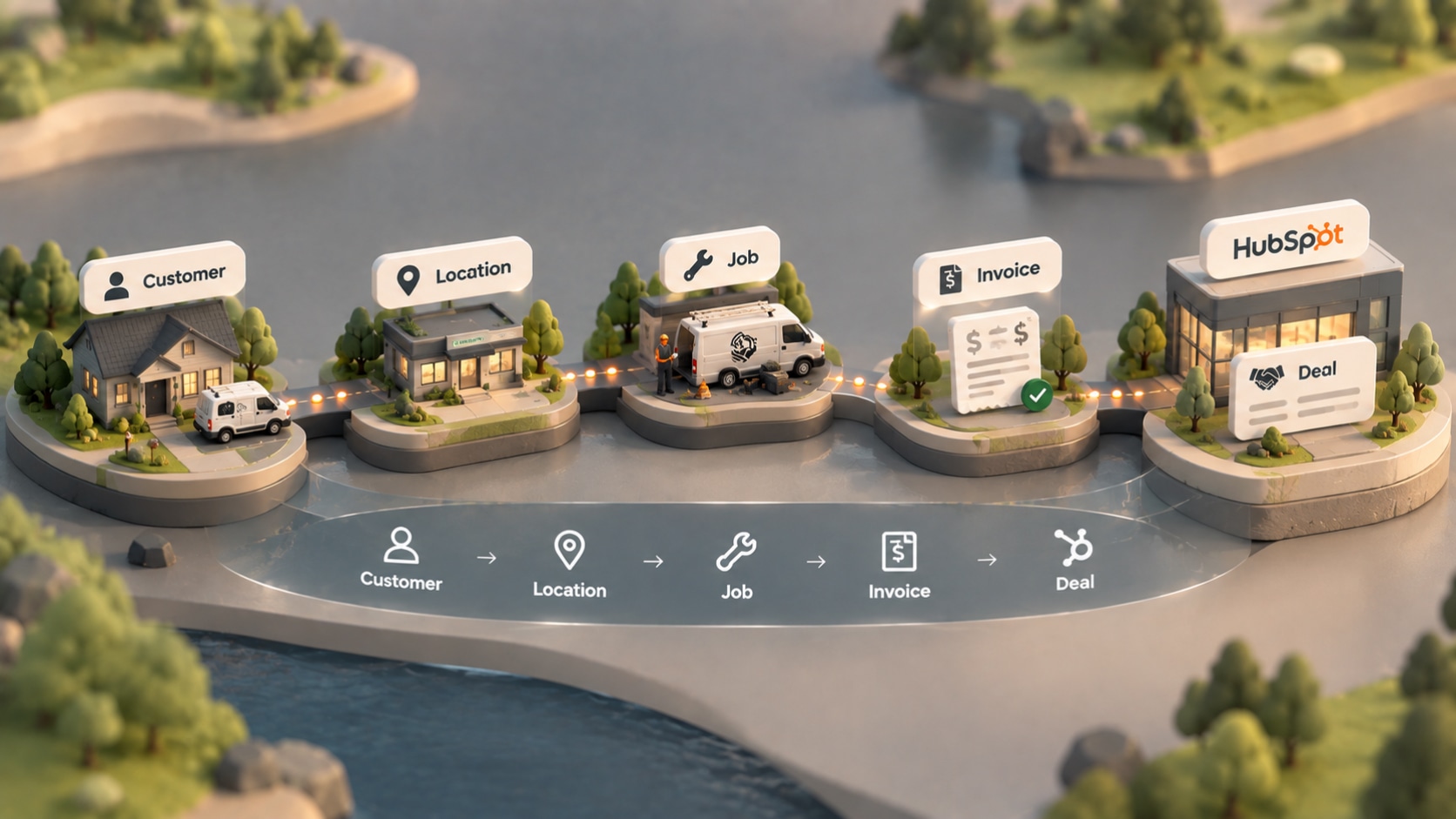
A ServiceTitan invoice is part of a larger operational hierarchy.
It belongs to a job.
The job belongs to a service location.
The service location belongs to a customer.
HubSpot has a different object structure.
The integration therefore needs to preserve those relationships rather than flatten everything into a single contact record.
A typical mapping might look like:
ServiceTitan Job + Invoice → HubSpot Deal
ServiceTitan Customer Location → HubSpot Company
ServiceTitan Billing Contact → HubSpot Contact
This gives sales and marketing teams a much more complete picture of the customer.
2. Match Existing Customers Before Creating New Ones
One of the easiest ways to damage CRM data is to assume every incoming record is new.
A reliable sync should first ask:
"Do we already know this customer?"
The source material describes using multiple identifiers—including email, phone number, and service address—to improve identity matching.
This matters because customers do not always provide information consistently.
A customer might use a different email address.
A CSR might enter a slightly different name.
A phone number might be formatted differently.
A strong matching strategy looks beyond a single field and uses available context to determine whether the record already exists.
The goal is simple:
Update the right customer instead of creating another one.
3. Protect the Sync During Peak Demand
A good integration should assume that traffic will spike.
When extreme weather hits, contractors can suddenly receive a flood of calls, bookings, jobs, and invoices.
The integration must be able to absorb that increase without losing transactions.
That means using mechanisms such as:
- queueing
- batching
- checkpointing
- throttling
- retry logic
- exponential backoff
Instead of pushing every transaction immediately and hoping the API accepts it, the system can temporarily buffer the workload and process it safely.
That distinction is critical.
A reliable integration should treat API limits as a scheduling problem—not a data-loss problem.
4. Establish Clear Data Ownership
Two-way synchronization does not mean both systems should overwrite everything.
Each platform should have clear ownership of specific fields.
For example:
ServiceTitan can remain the source of truth for operational and financial information such as invoice amounts, payment status, job details, technician assignments, and service addresses.
HubSpot can remain the source of truth for marketing information such as campaign attribution, UTM parameters, lifecycle stages, and communication preferences.
This prevents the integration from constantly overwriting valuable information.
5. Close the Attribution Loop
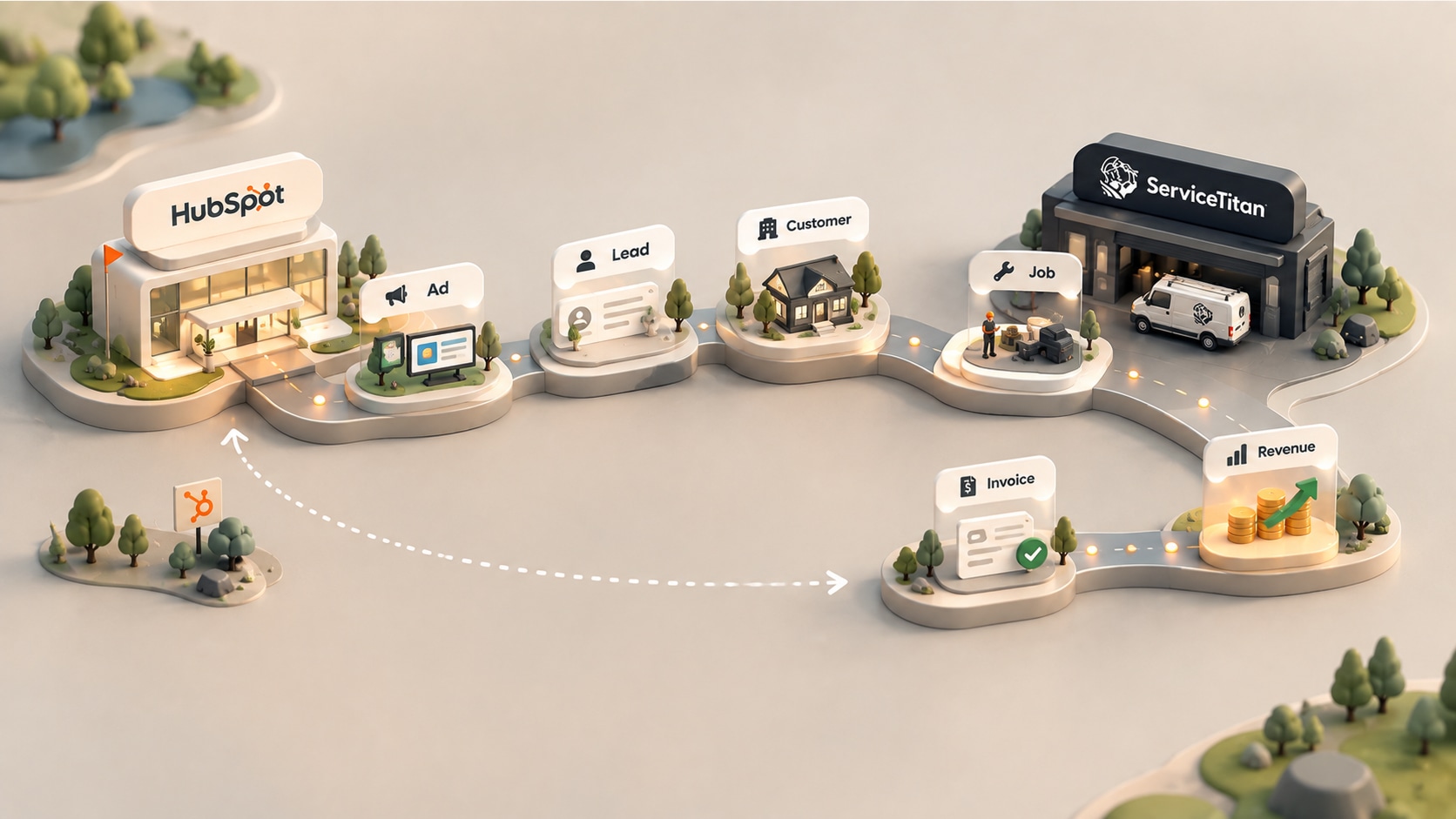
This is ultimately the biggest reason to connect invoices to HubSpot Deals.
Consider the full journey:
Google Ad → HubSpot Lead → ServiceTitan Job → Completed Invoice → HubSpot Deal
Now the business can connect marketing activity with actual revenue.
Instead of asking:
"Which campaign generated the most leads?"
leadership can ask:
"Which campaign generated the most completed revenue?"
That is a much more valuable metric.
It gives marketing a financial feedback loop and gives leadership a clearer picture of where growth is actually coming from.
A Purpose-Built Approach: Synkazo
This is where a purpose-built synchronization platform such as Synkazo fits into the picture.
Rather than asking a contractor to build and maintain another piece of middleware, synkazo is designed specifically to connect HubSpot with field-service platforms such as ServiceTitan and Dataforma, plus one-way Texada-to-HubSpot sync.
The goal is straightforward:
Connect the front office with the field without turning the contractor into an integration company.
Synkazo brings together the capabilities required for a production-grade synchronization workflow.
Two-Way Synchronization
Data can move between HubSpot and the field-service platform, helping marketing, sales, and operations work from a more connected customer record.
Automated Record Matching
Customer information can be matched across systems to reduce duplicate records and preserve relationships between contacts, companies, locations, jobs, and deals.
Queue and Rate-Limit Protection
The synchronization process is designed to handle high transaction volumes without simply pushing every API request directly through the system.
Faster Deployment
Instead of starting a six-week custom development project, Synkazo is positioned as a turnkey integration that can be deployed directly through the marketplace.
Less Maintenance
The underlying integration infrastructure is managed as part of the product rather than becoming another custom application the contractor has to maintain.
The Business Case for Connecting Invoices to Deals
The value of invoice synchronization is ultimately bigger than moving one number from ServiceTitan to HubSpot.
It creates a connected revenue story.
A marketer can understand where a customer originated.
A salesperson can see what happened after the estimate.
An operations team can continue managing the job in ServiceTitan.
Leadership can see how marketing activity connects to completed revenue.
And customers receive more relevant communication because the CRM has better visibility into what has actually happened in the field.
That is the real purpose of synchronization.
Not simply moving data—but making the data useful.
From Operational Split-Brain to One Customer Story
ServiceTitan knows what happened in the field.
HubSpot knows how the customer entered the business and how the relationship is being managed.
When those systems remain disconnected, the company sees only fragments of the customer journey.
When they work together, the story becomes much clearer:
Lead → Customer → Job → Invoice → Revenue → Marketing ROI
That connection can change how a contractor measures marketing, manages its pipeline, serves customers, and makes growth decisions.
For businesses looking to eliminate the gap between their CRM and field-service operations, Synkazo provides a purpose-built way to connect those systems without the cost and complexity of maintaining a custom integration.
We’ll connect a sandbox and map one of your real objects on the call. Thirty minutes, no slide deck.
Request a demo