It usually starts with a small mismatch.
A customer calls your office and books a repair. The CSR adds the customer to ServiceTitan. A few days later, that same customer fills out a form on your website using a slightly different name and a new email address.
Now you have two records.
One says the customer is new. The other says they have been a customer for years.
Multiply that by hundreds—or thousands—of customers, and a small data problem becomes a serious operational problem.
That is exactly what happened to Ken, the owner of a growing 15-truck HVAC and plumbing company.
On one screen, HubSpot showed a healthy marketing pipeline: £12,000 spent on Google Local Services Ads and PPC campaigns, generating 120 qualified leads.
On the other, ServiceTitan showed what was actually happening in the field: jobs being dispatched, invoices being paid, technicians visiting homes, and customers signing maintenance agreements.
But the numbers didn't line up.
Some customers were receiving "Welcome" emails even though they had been customers for years. Completed jobs weren't connected to the marketing campaigns that generated them. And revenue that clearly existed in ServiceTitan was nowhere to be found in HubSpot.
Ken wasn't dealing with a marketing problem or a ServiceTitan problem.
He was dealing with a data problem.
This is the operational split-brain: marketing and sales know what happened before the booking, while operations knows what happened after it. When those two systems don't share reliable information, the business is forced to operate with two different versions of reality.
Here are seven of the most common reasons it happens.
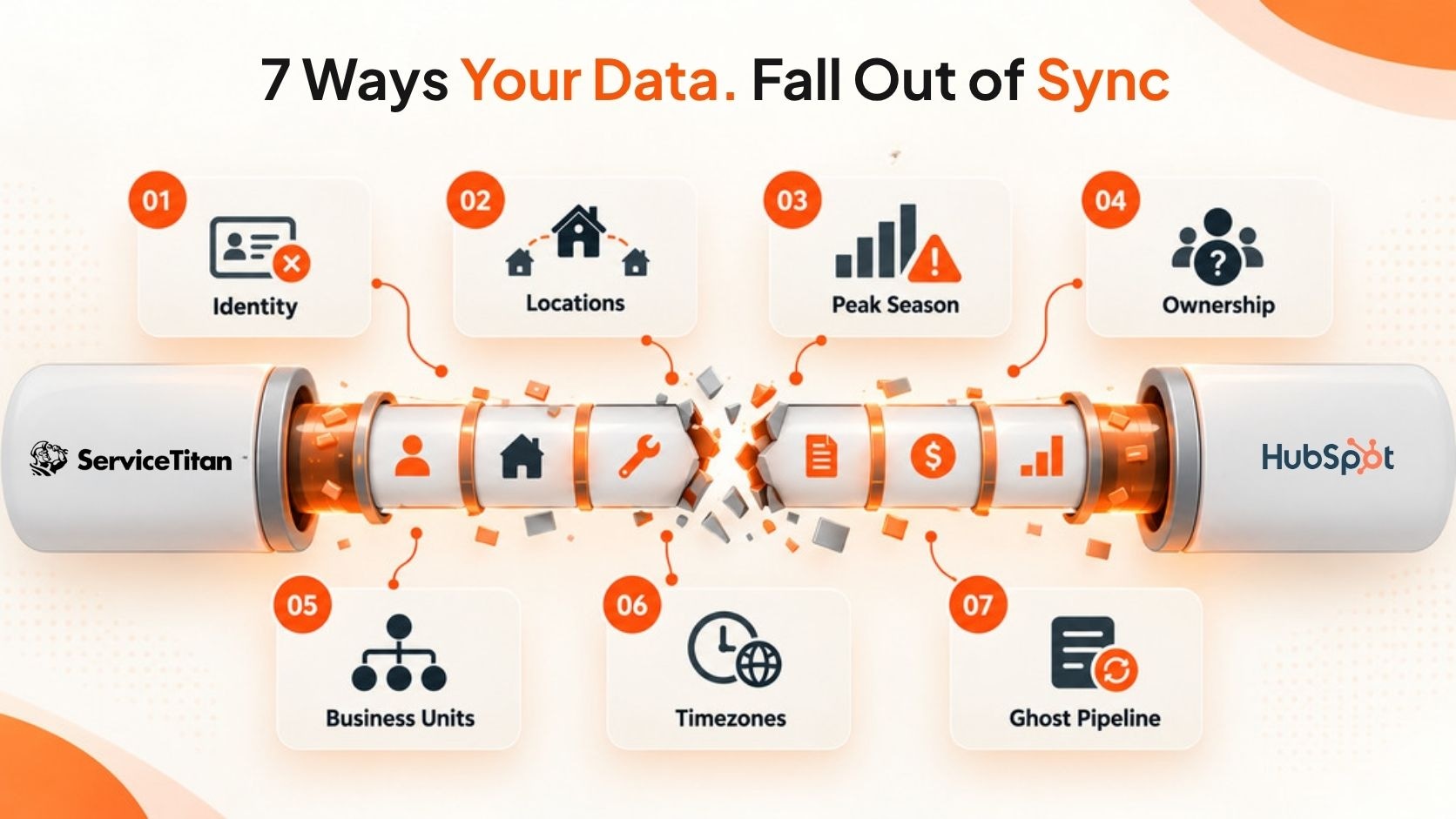
1. The Identity Problem: Email vs. Phone + Service Address
The first problem is surprisingly simple: HubSpot and ServiceTitan don't think about a customer in exactly the same way.
HubSpot is primarily contact-centric, with email playing an important role in identifying records. ServiceTitan is built around the realities of field service—customers, phone numbers, physical service locations, jobs, and equipment.
Imagine a homeowner calls your office.
Your CSR creates:
Jon Doe
Phone: 555-1234
Address: 25 Main Street
Two weeks later, Jon visits your website and submits a quote request:
John Doe
Email: [email protected]
Address: 25 Main St.
To a human, these are obviously the same person.
A basic integration may not see it that way.
If we use just one identifier or require fields to match exactly, even a small difference can cause the system to create a new contact instead of updating the existing record. As these mismatches accumulate, they lead to duplicate contacts, messy marketing lists, and reporting you can not fully trust.
The lesson: customer matching needs more than one piece of information.
2. The Multi-Location Problem: When One Customer Has Many Properties
Now consider a commercial customer.
One company might have a headquarters, three retail locations, and several warehouses. Each location can have its own equipment, service history, jobs, and technicians.
ServiceTitan can represent those relationships. A simple CRM record often cannot.
When an integration doesn't understand the parent-child relationship between a customer and its service locations, it can flatten everything into separate company records. The result is a CRM full of disconnected addresses instead of one clear customer relationship.
That creates a frustrating experience for everyone.
A sales representative may see a company in HubSpot but not the service history for its individual locations. An office manager may struggle to understand which equipment belongs to which site. Marketing may not know which customers already have an active relationship with the company.
The problem isn't simply "bad data."
It's lost context.
3. Peak Season Can Break a Weak Integration
Data synchronization is easy to underestimate—until your busiest day of the year arrives.
A heatwave hits. Phones start ringing. Emergency jobs flood the dispatch board. New customers are being created, appointments are moving, estimates are changing, and invoices are closing.
Suddenly, your integration has hundreds or thousands of records moving between systems.
ServiceTitan's APIs have rate limits, including a stated limit of 60 requests per second per application per tenant for regular APIs. When an integration pushes too much data too quickly, requests can be throttled with HTTP 429 errors.
A basic trigger-based automation may simply fail or leave records waiting for another attempt.
And that's the worst possible time to discover your integration isn't resilient.
Your team is busy serving customers—not searching for missing records.
A reliable integration therefore needs more than the ability to send data. It needs queues, checkpoints, throttling, retries, and state management so temporary API limits don't turn into permanent data gaps.
4. The Overwrite Problem: Which System Is Right?
Two-way synchronization sounds like the perfect solution.
But there is a catch.
If both systems can update the same field, which system gets the final say?
Suppose a technician corrects a customer's address in ServiceTitan while working at the property.
Later, a HubSpot workflow updates information associated with that same contact.
Without clearly defined ownership rules, one system can overwrite information maintained by the other.
This is why every important field needs a defined System of Record (SoR). Service information might belong to ServiceTitan, while marketing lifecycle information might belong to HubSpot.
The goal isn't simply to make two databases identical.
The goal is to make sure each system has the right information and knows where that information should come from.
5. Business Units Disappear—and So Does Your Reporting
Growing service companies often operate across multiple trades, branches, or business units.
You might have:
- HVAC
- Plumbing
- Electrical
- Multiple regional branches
That information matters.
If a job comes into HubSpot without its Business Unit context, all of your operational data can start looking like one giant bucket.
And that makes targeted marketing much harder.
You may want to send an HVAC maintenance offer only to customers who have previously used your HVAC service—not everyone who has ever called your company for plumbing.
Without proper segmentation, your marketing becomes less relevant and your reporting becomes less useful.
6. Timezones Can Turn Accurate Data Into Inaccurate Reports
Sometimes the data isn't missing.
It's simply showing up at the wrong time.
For closed-loop reporting, the timing of a job matters. You need to know when a job was completed, when it was invoiced, and when the revenue should be attributed to a campaign.
The source material notes that ServiceTitan API endpoints can return timestamps using UTC and local timezone offsets. If the integration doesn't correctly translate those timestamps, a job completed late Friday could appear as Saturday revenue inside HubSpot.
The result is subtle but damaging.
Marketing sees one number.
Finance sees another.
Operations sees a third.
Eventually, people stop trusting the dashboard.
7. The Ghost Pipeline: When Jobs Change but HubSpot Doesn't
This is one of the easiest problems to miss.
A customer books a job.
The integration creates a HubSpot deal worth $8,500.
Everything looks perfect.
Then the customer reschedules.
Later, they cancel.
The dispatcher updates the job in ServiceTitan—but the HubSpot deal doesn't change.
Now you have a ghost deal.
It looks active in the CRM even though the job no longer exists in the same form operationally. Multiply that across hundreds of jobs and your pipeline, forecasts, and conversion metrics slowly become fiction.
This is the fundamental weakness of simple "if this happens, do that" automation.
Real businesses don't stand still.
Jobs are rescheduled. Estimates are updated. Customers cancel. Technicians are reassigned. Addresses change. Invoices close.
A serious integration has to keep up with those changes—not just react to the first event.
So, How Do You Fix It?
The answer isn't simply "connect ServiceTitan to HubSpot."
The real challenge is building a connection that understands how field-service data behaves.
That's where Synkazo comes in.
Synkazo: A Purpose-Built Sync Engine for the Trades
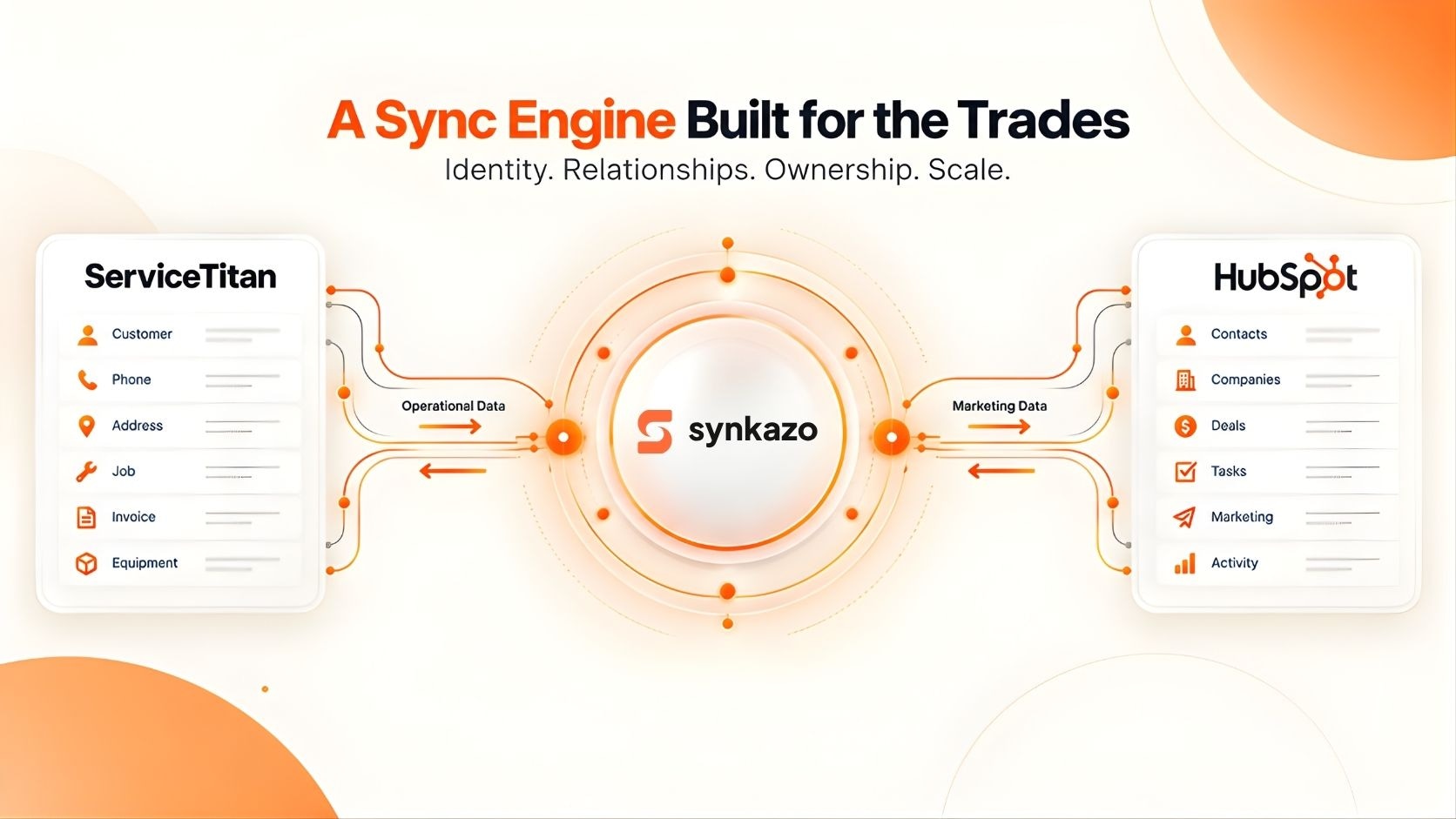
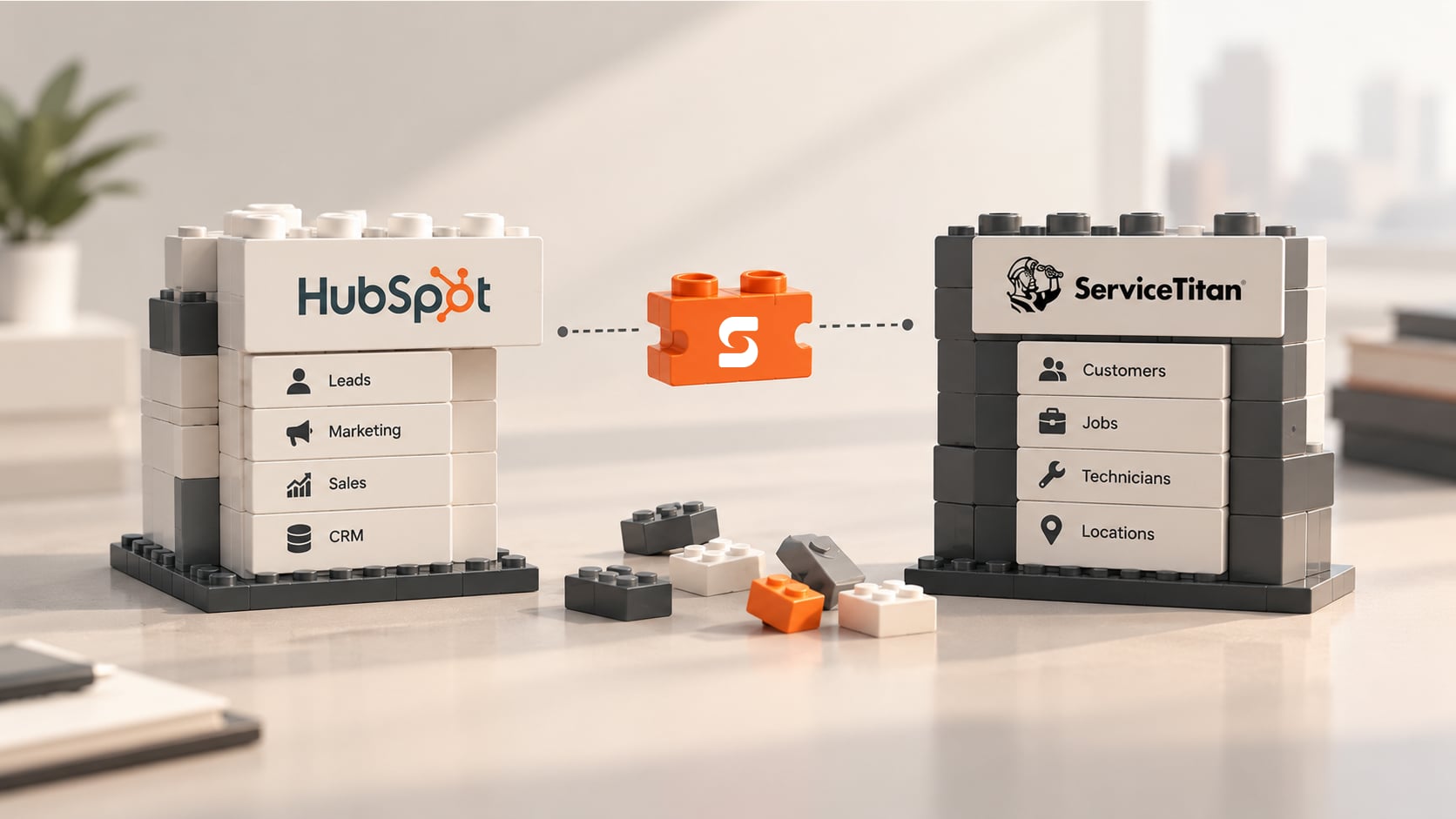
synkazo is a managed sync engine designed to connect HubSpot with field-service platforms including ServiceTitan and Dataforma, plus one-way Texada-to-HubSpot sync. According to the source material, it can be installed from the HubSpot App Marketplace in under an hour, without building and maintaining a custom integration.
More importantly, Synkazo is designed around the problems that cause synchronization to fail in the first place.
It understands customer identity
Instead of relying on a single field, Synkazo uses a composite approach involving email, phone number, and service address to help identify whether incoming data belongs to an existing customer.
That means "Jon Doe" and "John Doe" don't automatically become two customers just because one record was created by a CSR and the other came through a website form.
It preserves operational relationships
Customers, service locations, jobs, estimates, equipment, and memberships aren't just isolated records. They have relationships.
Synkazo is designed to preserve those relationships when moving operational data into HubSpot instead of simply flattening everything into disconnected contacts and companies.
It supports controlled two-way synchronization
The goal isn't to make both systems fight over the same data.
Synkazo uses ongoing synchronization and field-level ownership so operational information can remain authoritative in ServiceTitan while marketing information remains managed in HubSpot.
It is built for high-volume operations
During peak season, synchronization needs to survive API limits rather than collapse under them.
The source describes Synkazo's queue-based approach as batching, checkpointing, throttling, and retrying transactions when necessary.
That's the difference between simply moving data and actually managing synchronization.
The Real Goal Isn't a Cleaner CRM
A clean HubSpot database is useful.
Accurate ServiceTitan data is useful.
But the bigger opportunity is what happens when the two finally agree.
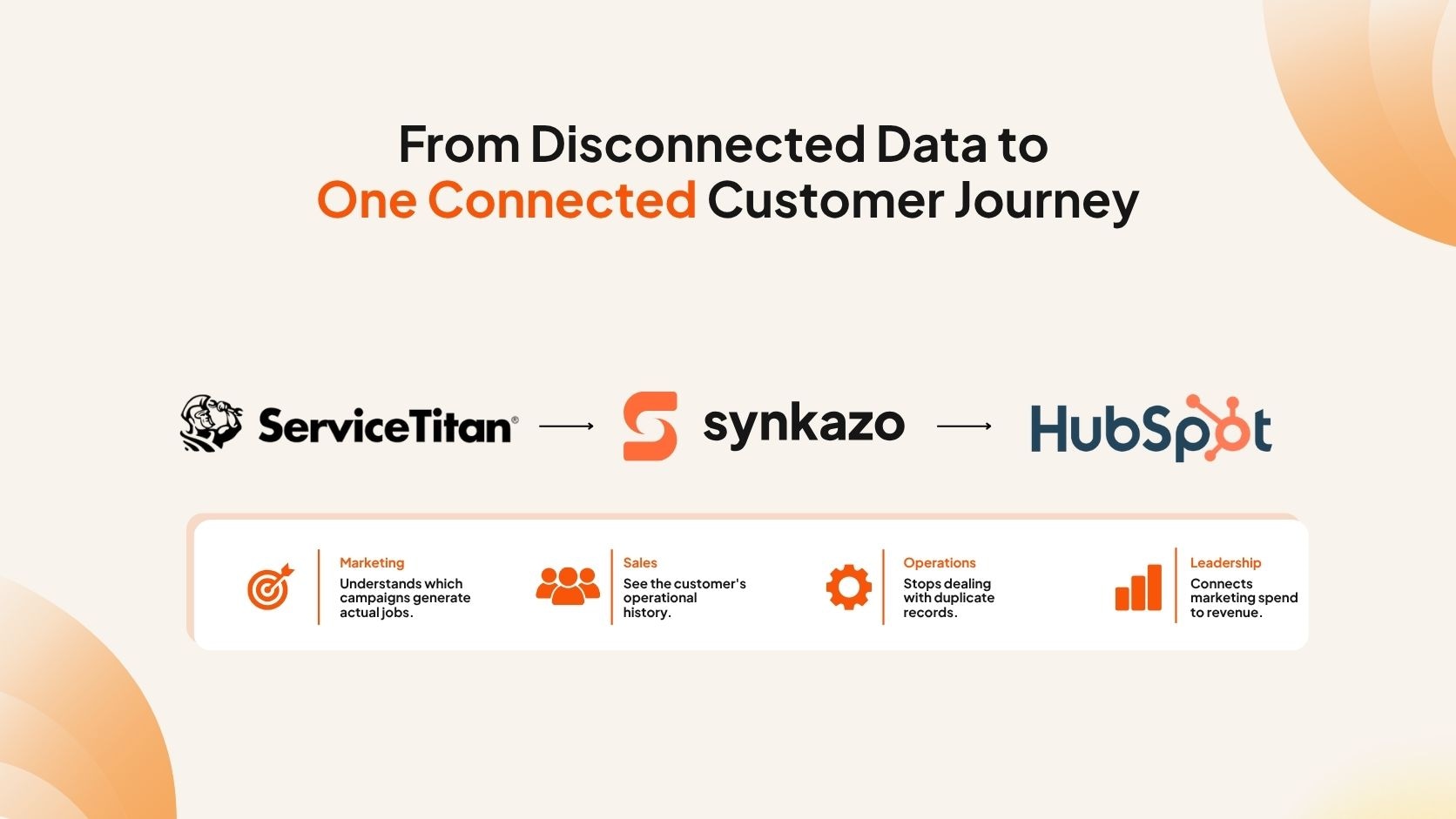
A marketing manager can see which campaigns generate actual jobs—not just leads.
A sales representative can understand a customer's operational history.
An operations team doesn't have to keep correcting duplicate records.
Leadership can finally connect marketing spend → booked job → completed work → invoiced revenue.
That's the real value of fixing the ServiceTitan–HubSpot data gap.
You don't just get two systems that exchange information.
You get one connected view of the customer journey.
And for a growing trades business, that can turn disconnected data from an ongoing headache into something the business can actually use to make better decisions.
We’ll connect a sandbox and map one of your real objects on the call. Thirty minutes, no slide deck.
Request a demo