It is Monday morning. Leadership is reviewing last month's performance.
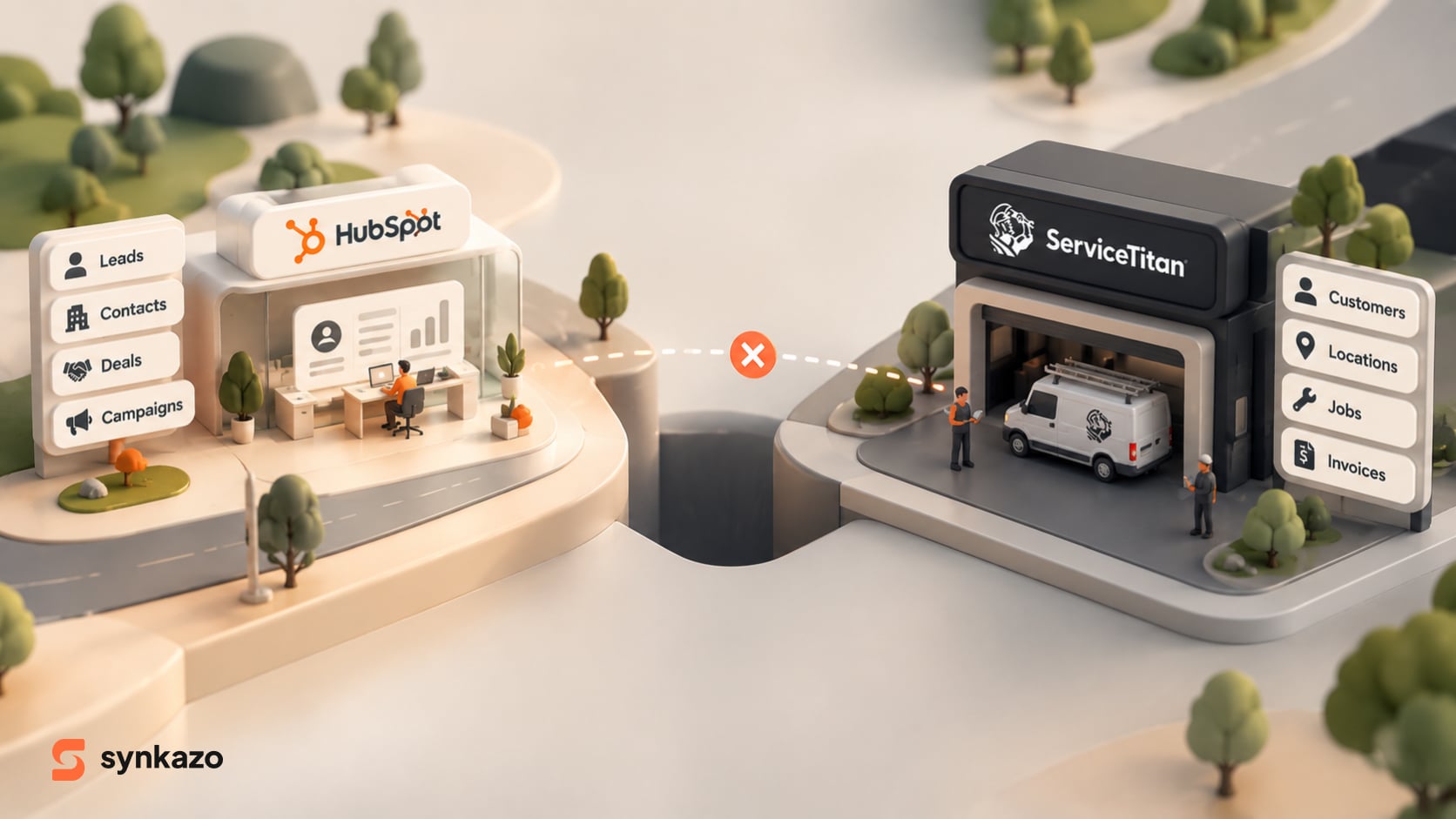
HubSpot shows hundreds of ad clicks, new leads, and strong campaign engagement. ServiceTitan shows completed jobs, invoices, and revenue.
Then the CEO asks:
“Which marketing campaign generated the $22,000 commercial HVAC installation we closed on Friday?”
Silence.
Marketing knows where the lead came from. Operations knows what happened in the field. Finance knows what was invoiced.
But nobody can easily connect the lead to the revenue.
This is the operational split-brain facing many growing trade businesses.
HubSpot manages the customer journey through marketing and sales. ServiceTitan manages what happens in the field—customers, locations, jobs, and invoices. When these systems operate separately, the business sees two halves of the same customer story.
The Real Cost of Disconnected Data

The problem quickly becomes more than a reporting inconvenience.
Manual Work
When systems do not communicate, employees become the integration layer. Teams spend time copying customer information, job details, and invoice values between platforms.
As the business grows, this manual work becomes expensive, repetitive, and increasingly difficult to keep accurate.
Marketing Without Revenue Context
HubSpot may show that Google generated a lead.
But did that lead become a $500 service call or a $22,000 installation?
Without completed-job and invoice data flowing back into HubSpot, marketing teams are forced to optimize around leads and clicks rather than actual revenue.
The question should not simply be:
“Which campaign generated the most leads?”
It should be:
“Which campaign generated the most valuable customers?”
A Disconnected Customer Experience
When HubSpot cannot see what happened in ServiceTitan, marketing automation can miss important moments.
A customer who just completed a major installation might still receive prospect-focused promotions, while the business misses opportunities for reviews, maintenance plans, or relevant follow-ups.
The data exists.
It is simply trapped in another system.
Why the Obvious Solutions Aren't Always Enough
There are two common ways businesses try to solve the problem: custom development and generic automation tools.
Custom API Integration
It is understandable that a custom integration provides flexibility, but it also creates a new piece of software the business must maintain.
Development can involve a substantial initial investment, along with continuous effort whenever APIs, fields, authentication, or business requirements change.
For a contractor, integration maintenance can quickly become an unnecessary engineering responsibility.
Generic Automation Tools
Tools such as Zapier and Make are excellent for simple workflows.
But syncing customers, service locations, jobs, invoices, and CRM deals is more complicated than:
When X happens → Do Y
A reliable integration needs to understand customer identity, preserve relationships, handle duplicate records, manage API limits, and recover when transactions fail.
ServiceTitan also places specific requirements around integration paths and subscription tiers, making the choice of integration architecture a commercial decision as well as a technical one.
What a Better Integration Looks Like

A good integration does not have to be complicated. It simply needs to make sure the right information reaches the right place, at the right time.
- Match customers accurately: Use email, phone, and service address to identify existing customers and prevent duplicates.
- Maintain customer relationships: Keep ServiceTitan customers, locations, jobs, and invoices linked to the right HubSpot records.
- Handle busy periods reliably: Use queues, retries, and safeguards to prevent data loss during API limits or traffic spikes.
- Connect revenue to marketing: Sync completed invoices back to HubSpot Deals to track which leads and campaigns generated revenue.
That creates a complete journey:
Marketing Campaign → Lead → Job → Invoice → Revenue
Now leadership can finally see what marketing activity actually produced.
Where Synkazo Fits
This is the problem Synkazo is built to solve.
synkazo connects HubSpot with field-service platforms such as ServiceTitan, Dataforma, and Texada through a purpose-built synchronization layer. Direction depends on the connector; Texada currently flows one way into HubSpot.
Instead of forcing contractors to maintain custom middleware or piece together dozens of automation workflows, Synkazo focuses on the problems that matter most:
- Two-way synchronization where supported, with one-way Texada-to-HubSpot sync
- Intelligent record matching
- Duplicate prevention
- Reliable data processing
- Job and invoice synchronization
- Closed-loop revenue attribution
Most importantly, Synkazo is designed specifically around the realities of field-service businesses rather than generic trigger-and-action automation.
From Split-Brain Data to One Business Story

HubSpot already knows where your customers came from.
ServiceTitan already knows what happened after they arrived.
The missing piece is connecting those two stories.
With the right integration, the journey becomes:
Lead → Customer → Job → Invoice → Revenue → Marketing ROI
That is more than data synchronization.
It gives marketing, sales, operations, and leadership a shared view of what is actually happening inside the business.
Synkazo provides a practical, purpose-built, and reliable way to make that connection—without turning your integration into another software project your team has to build and maintain.
We’ll connect a sandbox and map one of your real objects on the call. Thirty minutes, no slide deck.
Request a demo